Yes. The City of Johns Creek requires a fence permit both to put up a new fence and to replace an existing one. You apply through the city’s online Customer Self-Service portal with a site plan, and the residential fee is $75. Your HOA’s approval is a separate step, because the city does not enforce subdivision covenants.
Upright Johns Creek Fencing plans fences around these rules across Johns Creek and nearby cities, with the installation done by licensed and insured fencing contractors. This guide collects what a homeowner needs before the first post goes in: the permit itself, the zoning rules it applies, the private approvals and the physical limits on where a fence can go.
The permit: when you need one and how to apply
The city’s Planning and Zoning answer is direct: to erect a new fence, or to replace an existing fence, a fence permit is required. Applications go through the Customer Self-Service (CSS) portal, the same system the city uses for other residential permits. The Community Development fee schedule lists a fence permit at $75 for residential property and $100 for commercial property.
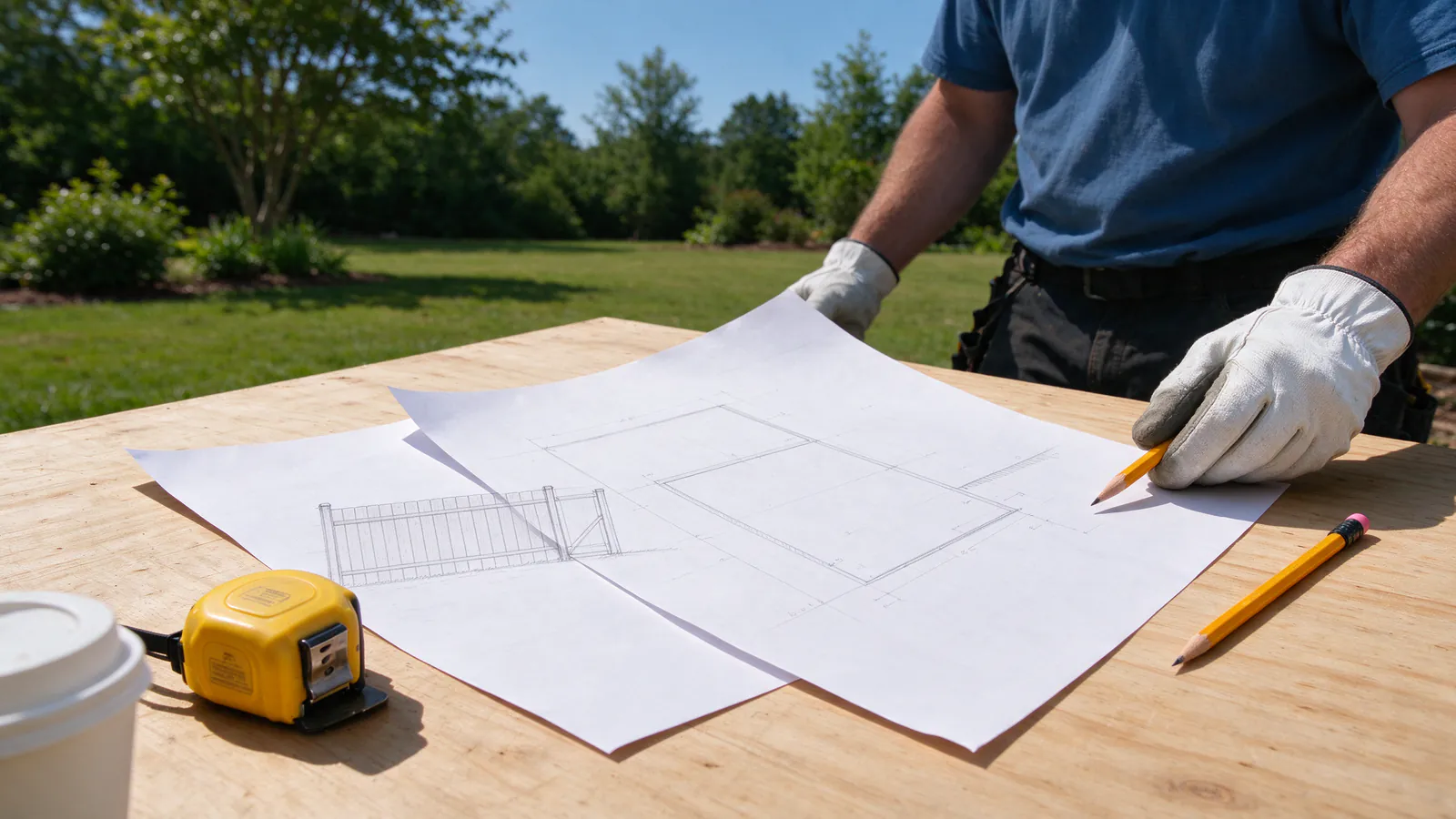
The application centers on a site plan: a drawing of the lot showing where the fence goes, how tall it is, what it is made of and where any gates sit. The usual starting point is the recorded plat for the property. Copies of final location plats are on file for many, though not all, homes in the city, and you request one from the City Clerk’s Office through a Request for Public Records using the street address or the parcel identification number. Faxed plats are not accepted for permit submittals because they distort.
There is one exception in the zoning code: fences built for agricultural purposes in the AG-1 district are exempt from permit requirements. For a typical subdivision lot, plan on a permit.
What the Johns Creek zoning code says about fences
The rules the permit applies are in Section 4.11 of the Johns Creek zoning ordinance, Fences and Walls. The published text sets out the following; confirm each with the city for your lot, because a code can be amended and some lots carry special conditions.
| Rule | What the code says |
|---|---|
| Height | Fences and walls in residential districts may not exceed 8 feet from grade; columns and ornaments may extend up to 3 feet higher |
| Setback from the street | At least 3 feet from a public right-of-way, with a landscape strip of at least 3 feet between the fence and the right-of-way |
| Sight distance | Fences, walls and plantings cannot block the minimum sight distance near intersections and driveways |
| Vehicle gates | No part of an automobile gate within 20 feet of a public right-of-way |
| Finished side | Fences along property lines are built with the finished side toward the neighboring property |
| Street-facing materials | In single-family detached developments, wire and plastic fencing, including chain link with plastic or wooden inserts, may not be used adjoining a street right-of-way |
| Barbed wire | Not approved on single-family lots |
Two of these change the most designs. The street-facing materials rule means chain link and wire fences in subdivisions belong in side and rear yards away from the street. The 20-foot rule for vehicle gates means a driveway gate usually sits well back from the street, which affects whether a swing or slide gate fits.
HOA approval is a separate step
Many Johns Creek subdivisions are governed by covenants and deed restrictions that go further than the city’s ordinances. The city’s guidance is plain: these covenants are private agreements between property owners and are not enforced by the city, so before adding a fence you should check with your homeowners’ association.
In practice, the HOA’s architectural committee usually reviews the fence style, height, color or stain, and where it sits on the lot; some limit fences in front of the house or require one style throughout the neighborhood. The committee typically wants a site plan and a picture or drawing of the style. The same site plan that goes to the city works for the HOA, so drawing it once and submitting to both avoids rework. Getting HOA approval before the city permit also avoids a permitted fence the HOA asks you to change. More on that process is in the HOA approval guide.
Property lines, plats and surveys
A plat shows the lot’s dimensions and easements; it does not put marks on the ground. An existing fence is not proof of the property line either, and replacing a fence in the same spot can repeat an old mistake. When the new fence will sit close to the line, a licensed surveyor locates or resets the corner pins and the line is set from them. Building a few inches inside the line also leaves room to maintain the fence from your own side.
Easements matter too. Drainage and utility easements commonly run along rear and side lot lines and are shown on the plat. A fence inside an easement may have to be removed if the easement holder needs access, and fences that cross a drainage swale need an opening or a raised bottom so water still flows. The survey guide goes further into when a survey is worth it.
Utilities: Georgia 811 before the first hole
Georgia law requires a locate request through Georgia 811 before excavating with mechanized equipment, which includes a powered post-hole auger. After the request, the excavator waits at least 3 business days for utilities to mark their lines, and a normal locate request is good for 30 calendar days after its effective date. Hand digging is not covered by the requirement, but Georgia 811 still recommends a call before any digging. Private lines are not marked by 811, so irrigation, landscape lighting, invisible dog fences and lines to detached buildings need to be pointed out on site. The 811 guide covers the details.
Trees, buffers and the river corridor
A fence line often runs past trees. In Johns Creek, permission is needed to remove a tree that sits in a zoning buffer, a stream buffer, the Chattahoochee River Corridor or another protected area such as a required landscape strip, or that qualifies as a specimen tree. Requests go through the same CSS portal. It is often simpler to route the fence around a protected tree, leaving room for the trunk and roots, than to request removal.
Properties near the Chattahoochee have another layer. The city enforces the Metropolitan River Protection Act, which treats the corridor as extending 2,000 feet from the river’s banks and restricts both clearing and new impervious surfaces by vulnerability category. A fence itself is a small footprint, but clearing a new line through wooded ground near the river should be checked first.
Pools need a barrier, not just a fence
A backyard pool needs a barrier that meets the International Swimming Pool and Spa Code as adopted with Georgia’s amendments, which set height, openings, gaps and gate hardware, including self-closing and self-latching gates. The barrier is planned with the pool permit. An existing privacy fence can sometimes serve as part of the barrier, but only if it meets those requirements. The pool fence page explains what that involves.
Want the site plan drawn once for the city and the HOA?
It is part of every estimate, along with the 811 request.
How the rules change in nearby cities
Fence rules are set city by city, so the same fence can need a permit on one side of a boundary and not on the other.
| City | Fence permit | Notable rules |
|---|---|---|
| Johns Creek | Required for new and replacement fences ($75 residential) | 8 ft residential limit; no wire or plastic fencing along streets in subdivisions (confirm) |
| Sandy Springs | Required for new and replacement fences and gates | No new vinyl; masonry piers on street-facing runs; gates open inward and sit 30 ft from pavement |
| Peachtree Corners | Not required unless the fence needs footers | 4 ft front yards; corner lots 4 or 6 ft on the street side; vinyl-coated chain link only side and rear |
| Roswell | Not normally required; pool fences permitted with the pool | Front-yard height and transparency limits (confirm) |
| Milton | Required (confirm) | Rules on opaque fences visible from main roads and on equestrian fences (confirm) |
Alpharetta, Duluth, Suwanee, Dunwoody and Forsyth County around Cumming each have their own rules as well; the service areas page summarizes them. Rules marked “confirm” come from published code summaries rather than the city’s own fence page, so check them with the city before you rely on them.
Putting it in order
For most Johns Creek fences, the sequence that avoids rework is:
- Get the plat, and a survey if the line is close or uncertain.
- Choose the material, height and style with your HOA’s rules in hand.
- Draw the site plan and submit it to the HOA.
- Apply for the city permit through the CSS portal with the same site plan.
- Request the Georgia 811 locate at least 3 business days before digging.
- Install, posts first, then rails and boards or panels, then gates.
Apply before scheduling installation; review times vary with the city’s workload and with how complete the application is. If you would rather hand the paperwork off, or want to see what a fence costs first, the site plan and the 811 request are part of every Upright estimate.