You wanted vinyl
Sandy Springs does not allow new vinyl fences. An existing vinyl fence can be replaced in kind; anything new is wood, metal, masonry or another approved material.
Service area
Fences and gates in Sandy Springs, GA, planned for the city permit, its ban on new vinyl, masonry piers on street-facing runs and inward-opening gates.
Last Updated:
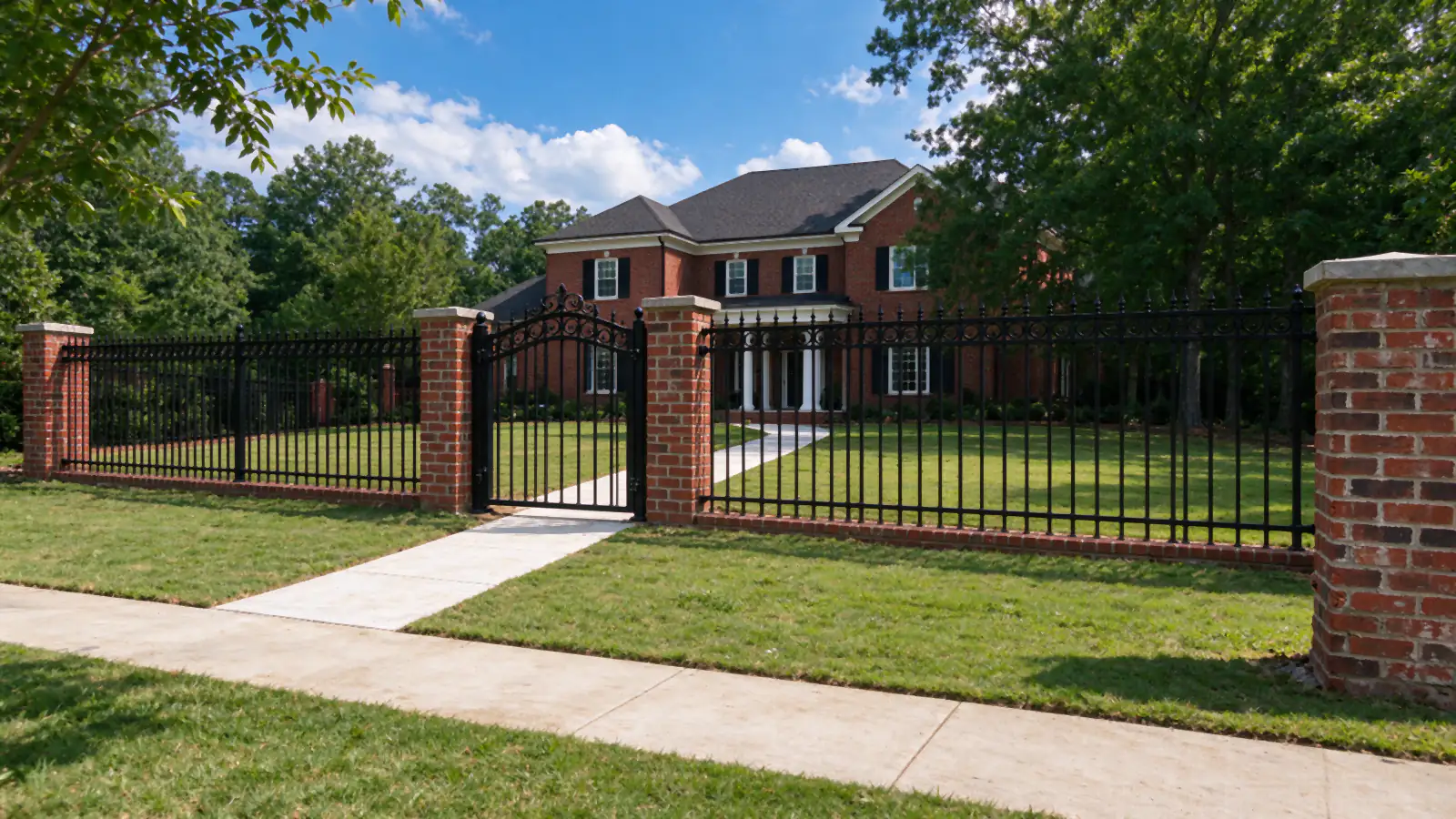
Sandy Springs does not allow new vinyl fences. An existing vinyl fence can be replaced in kind; anything new is wood, metal, masonry or another approved material.
Street-facing fences need masonry piers about every 24 feet and at every change of direction, and a 3-foot landscape strip when the fence is 6 feet or taller.
Gates must open inward, sit at least 30 feet from the edge of pavement, and stand-alone driveway gates need masonry piers. Vehicular and electronic gates are reviewed by the Building Division and the Fire Marshal.
Chain link is allowed only in side and rear yards, not parallel to a street, and it must be vinyl-coated.
Upright Johns Creek Fencing plans and installs fences and gates in Sandy Springs, with the work done by licensed and insured fencing contractors. Sandy Springs is a short drive down GA 400 from Johns Creek, but its fence rules are among the most specific in north Fulton, and they change the plan before anyone talks about price. The city requires a permit for every new fence and gate and for replacing an existing one, it does not allow new vinyl, and it sets design rules for any fence that faces a street.
Those rules come from Section 8.2.10 of the Sandy Springs Development Code, which the city attaches to its fence permit application as an agreement the owner signs. The sections below walk through what they mean for a real yard.
In most nearby cities, choosing between wood, vinyl and aluminum is a matter of taste and budget. In Sandy Springs it starts with the code. Fences and walls must be wood, brick, stacked stone, stucco, ornamental metal or another durable material the Director approves. Vinyl is prohibited, except that an existing vinyl fence may be replaced in kind. Barbed wire, razor wire and concertina wire are prohibited. Chain link is allowed only in side and rear yards where it does not run parallel to a street, and it must be vinyl-coated.
Color is regulated too: fences may be black, white or earth tones, and primary and neon colors are not allowed. For a wood privacy fence that means a natural or earth-tone stain; for metal it usually means black. A homeowner who has priced a white vinyl privacy fence elsewhere can find that the same plan is not permitted here, which is why the material conversation happens at the first visit rather than after the estimate.
The rules that most change the cost of a Sandy Springs fence apply to fences parallel to a street and located between the right-of-way and the building setback line. Every street-facing fence needs masonry piers, in brick, stone or stucco, separating fence panels at a maximum spacing of about 24 feet, and at any point where the fence changes direction. Piers must be at least 12 inches wide. Masonry piers go through a footing inspection, so they are scheduled as their own stage of the job.
Where a street-facing fence or wall is 6 feet or taller, a landscape strip at least 3 feet wide is required between the fence and the street. Front-yard heights are limited as well: between the primary street and the front wall plane of the house, a solid fence can be no more than 4 feet tall. It can go higher only with a spaced picket design approved by the Director, with gaps of at least 2 inches and a picket-to-opening ratio of at least 2 to 1 for vertical pickets. Side and rear fences, including solid privacy fences, can be up to 8 feet above grade, measured from finished grade to the top of the fence between posts. Columns and ornaments can rise up to 3 feet above the fence.
Finished sides face out. The code requires fences and walls to be built with the finished side facing the street and adjoining properties, away from what the fence screens. Board-on-board and shadowbox styles look finished from both sides, which makes this simple to meet.
Gates have their own set of rules. Whether they open by hand or electronically, gates on individual properties must open inward, toward the property, and must sit at least 30 feet from the edge of pavement. A gate may be up to 3 feet taller than the fence or wall it is attached to. Stand-alone gates, such as a gate across a private driveway, need masonry piers on both sides. Public and private streets cannot be gated.
Vehicular and electronic gates are reviewed by both the Building Division and the Fire Marshal’s Office, and inspections are required. Any fence or gate that includes electrical equipment, such as an automatic gate operator, also needs an electrical permit. For a long or sloped driveway, the 30-foot setback often decides whether a swing gate or a sliding gate fits, so the gate type is chosen with the setback measured on site.
The permit application asks for the fence’s height, design, materials, dimensions and color, and a site plan or survey showing where it goes is preferred. Because the code requires fence and wall footings to be entirely contained within the property, with no encroachment onto a property line, line certainty matters more than usual. Where the fence will sit near a lot line, the corner pins are located before the layout is finalized, and posts and piers are set inside them.
Before any powered digging, a Georgia 811 locate request goes in at least 3 business days ahead. Then the work follows the permit’s stages: pier footings and their inspection on street-facing runs, posts and panels, gates, and any final inspection the permit calls for. Pool enclosures are permitted as part of the pool permit and must meet the International Swimming Pool and Spa Code; when a pool is in the plan, the fence is designed to that standard from the start.
Some things carry over from Johns Creek. Sandy Springs is in Georgia’s Piedmont too, where clay subsoils are common, so posts get a drainage base and crowned concrete for the same reasons; what the auger finds on a given lot still decides the depth. HOA covenants are separate from the city’s code, and many Sandy Springs subdivisions have architectural review of their own. Typical Atlanta-area price ranges apply here as well; what changes in Sandy Springs is the scope, with piers, setbacks and permitted materials adding to the work on street-facing fences.
Neighborhoods along the Chattahoochee, such as Riverside and Huntcliff, can also fall inside the river corridor protected under the Metropolitan River Protection Act, which limits clearing near the river. Confirm with the city before clearing a new fence line in those areas.
Planning a fence in Sandy Springs?
Send the address and the rough length; the rules for that lot come first.
Yes. Sandy Springs requires a fence permit to install a new fence or gate and to replace an existing fence or gate, on residential and commercial property. Licensed contractors, owners and owners' representatives can apply through the city's online permitting portal.
Not a new one. The city's development code prohibits vinyl fencing except to replace an existing vinyl fence in kind. Wood, brick, stacked stone, stucco and ornamental metal are allowed, along with other durable materials the Director approves.
A solid or opaque fence between the street and the front wall of the house can be up to 4 feet. It can go taller only with a spaced picket design the Director approves, with gaps of at least 2 inches. Side and rear fences can be up to 8 feet.
Typical Atlanta-area ranges run about $20 to $30 per foot installed for a 6-foot wood privacy fence and $25 to $50 for aluminum. In Sandy Springs, masonry piers on street-facing runs, inward-opening gates set 30 feet back and the permit add to that, so street-front work usually costs more per foot than a rear yard line.
The city requires inspections for residential fences taller than 7 feet, footing inspections for masonry piers, and inspections for vehicular and electronic gates, which are also reviewed by the Fire Marshal's Office.
Send the rough length, the material you are considering and whether an HOA or pool is involved. Photos of the yard help.
Upright Johns Creek Fencing
office@uprightjohnscreekfencing.com
11340 Lakefield Dr, Johns Creek, GA 30097
Monday to Friday 8 AM to 6 PM; Saturday and Sunday 9 AM to 2 PM
Outside these hours, emergency calls only
Photos of the fence line, the corners and any gates help most.