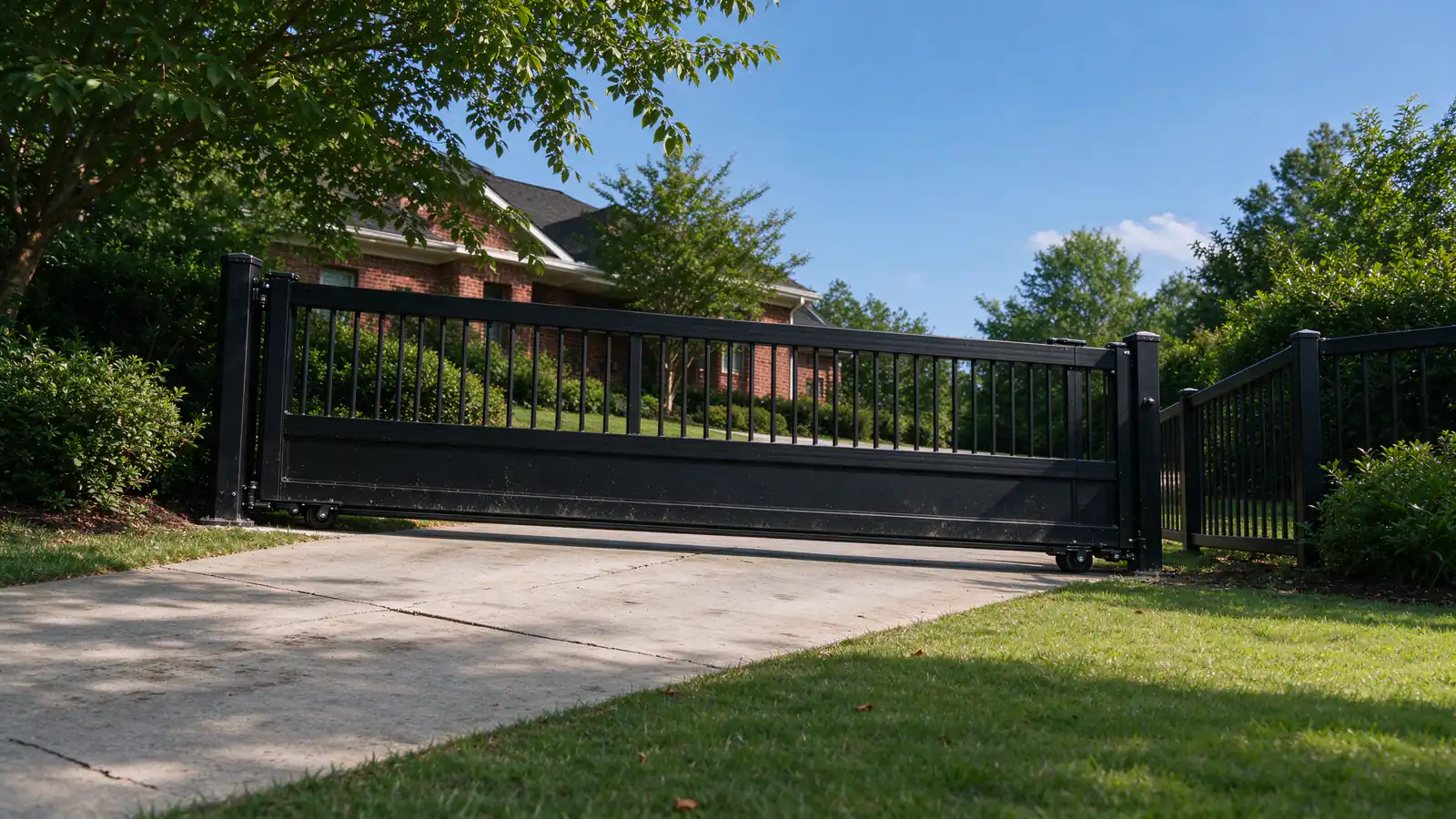
Swing gates suit level or gently sloped drives with open room inside the opening for the leaves to swing through. Sliding gates suit drives that slope up from the opening, short drives where cars would wait in the swing path, and lots with room along the fence line for the gate to roll into. Both can be manual or automated; automation adds operators and safety devices to either.
Upright Johns Creek Fencing builds driveway gates across north Fulton, and the choice usually comes down to the ground and the space around the drive. This guide compares them, and the automatic gate page covers adding an operator.
How each one works
A swing gate hangs on hinges from a post or column at one side and swings through an arc. Most driveways use a pair that meets in the middle, so each leaf is half the width. A single wide leaf is possible but carries more weight on one hinge post.
A sliding gate rolls sideways along the fence line. A V-track gate rides on wheels on a steel track set across the opening. A cantilever gate carries an extra counterbalance section and rides on rollers mounted to posts beside the opening, so nothing crosses the drive at ground level.
Slope
Slope is often the deciding factor in Johns Creek, where many drives rise or fall from the street. A swing gate must clear the ground through its whole arc. If the drive rises inside the gate, the leaves hit the pavement before opening fully. Swinging the leaves outward is usually not an option toward a street. A sliding gate travels across the slope rather than into it, and a cantilever gate rides above the ground, so it handles grade changes along its path as long as the bottom clears. The slope guide covers grade changes along the fence itself.
Room around the drive
A swing gate needs clear space inside the opening equal to the width of each leaf, with nothing parked, planted or built in the arc. A sliding gate needs clear space along the fence line beside the drive: roughly the width of the opening for a track gate, and more for a cantilever gate because of its counterbalance tail. Lots with a wall, a tree, a slope or a neighbor’s line beside the drive may not have it.
Distance from the street
A car waiting for a gate to open should be off the street. A swing gate set close to the road may leave too little room in front of it, and its leaves need space behind it to open. A sliding gate opens without swinging, so it can sit closer to the road, though stacking room for a car still matters. Many codes and HOAs set where driveway gates can sit relative to the right-of-way; check before choosing. The Johns Creek permit guide covers the city fence review.
Wind
A solid swing gate catches wind like a sail, and wind pushes against the operator and the hinge posts. Open picket designs in aluminum or steel catch far less. A sliding gate moves along its own plane, so wind loads it sideways rather than against its motion. On exposed lots, open designs are easier on either gate.
Hinge posts and columns
A swing leaf hangs its full weight off one side of its post, which is why gate posts are larger and deeper than line posts and why masonry columns are common at drives. A sliding gate puts less sideways load on its posts but needs a solid post or frame for the rollers and guides. The sagging gate guide shows what happens when a hinge post is undersized.
Materials
Driveway gates are usually built in aluminum or steel. Aluminum is lighter and rust-free; steel is stiffer and suits long or heavy gates. A long swing leaf in aluminum may need a reinforced frame. The aluminum vs steel guide compares them. Wood driveway gates are possible but heavy and prone to sag, and are usually built on a steel frame.
Upkeep
Swing gates have hinges and, if automated, arms or underground operators. Hinges need occasional lubrication and adjustment. Sliding gates have wheels, rollers and, for V-track gates, a track that must be kept clear of leaves, gravel and pine straw. In fall, a V-track in a wooded lot can fill quickly. Cantilever gates avoid the ground track but have rollers to keep in alignment.
Automation and safety
Both types can be automated. A swing pair usually needs an operator for each leaf; a sliding gate needs one. Automated gates must have entrapment protection, such as photo eyes and edge sensors, and the gate must be built for automation. Sliding gates also need their rollers guarded so hands cannot be pinched. Power, access controls and emergency access are part of the plan. The automatic gate page explains the standards.
Cost
Gate price depends on width, material, design, whether it is automated and the site work. A manual swing pair is often the simplest. A sliding gate needs a track or a cantilever frame and rollers; an automated swing pair needs two operators. Masonry columns, long runs of power and access controls add to either. The fence cost guide covers how gates are priced alongside fence.
Side-by-side
| Factor | Swing gate | Sliding gate |
|---|---|---|
| Sloped drive | Leaves can hit rising pavement | Travels across the slope |
| Space needed | Arc inside the opening | Run along the fence beside the drive |
| Near the street | Needs room behind it | Can sit closer, with room for a waiting car |
| Wind | Solid leaves catch it | Loaded sideways |
| Ground upkeep | Hinges | Track or rollers kept clear |
| Operators | Often one per leaf | One |
How to decide
Choose a swing gate when the drive is fairly level inside the opening and there is room for the leaves to swing. Choose a sliding gate when the drive slopes up from the gate, the gate sits close to the street, or there is room along the fence but not in front of the gate. Questions about a specific drive can go to the number at the top of the page or the form below, and the gate installation page covers walk and garden gates.