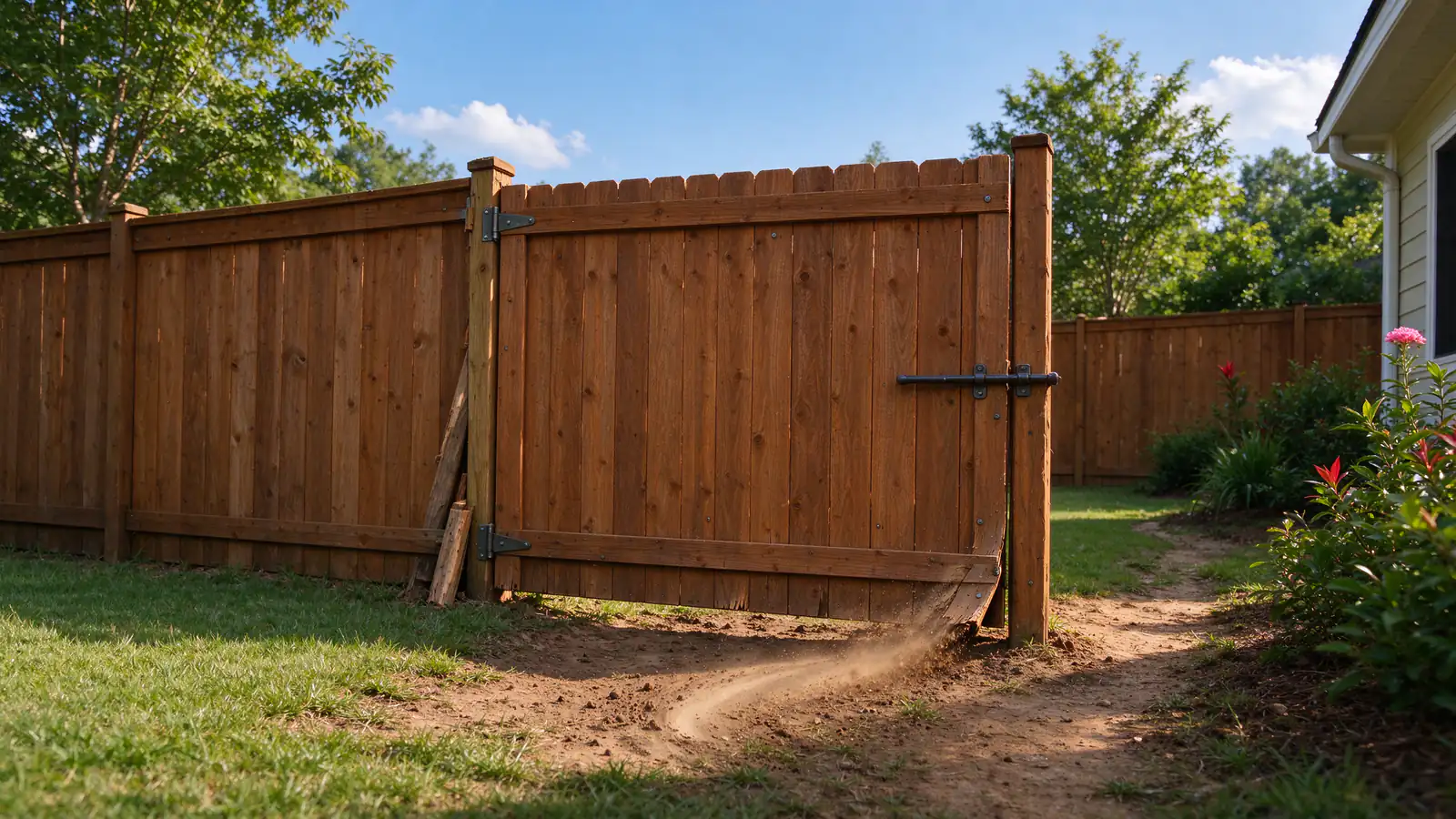
Usually for one of three reasons. The hinge post is leaning toward the opening, because it was set too shallow or its base has rotted. The gate frame is racking out of square, because it has no brace or the brace runs the wrong way. Or the hinges have loosened, because their screws have pulled out of the wood. A quick check tells you which, and each has a different fix.
Upright Johns Creek Fencing repairs and builds gates across north Fulton, and sagging is the most common gate call. This guide explains how to diagnose it.
How to tell which problem you have
Close the gate and look at three things:
- The hinge post. Hold a level against it. If it leans toward the opening, the post is the problem. Push on it; if it rocks, the footing has failed.
- The gate itself. Measure both diagonals of the gate frame, corner to corner. If they differ, the gate has racked out of square.
- The hinges. Lift the latch end of the gate. If the hinges shift or their screws move, they are loose.
More than one can be true at once. A loose hinge lets the gate drop, which loads the post harder, which leans it further.
A leaning hinge post
A gate hangs its full weight off one side of its hinge post, like a lever. Every swing and slam adds to that. Over time, a post set too shallow, in soft soil or without enough concrete tilts toward the opening and the latch side of the gate drops.
On north Fulton’s clay soils, wet ground makes this worse; a post that holds in a dry summer can lean after a wet winter. Wood posts can also rot at the soil line, which lets them bend there even when the concrete is solid.
The fix is to reset or replace the post: dig it out, set a new one larger and deeper, on a gravel base, with concrete crowned to shed water. A steel post is often the better choice for a heavy or wide gate. The leaning post guide covers the options, and the post depth guide explains why gate posts go deeper.
A gate racking out of square
A wood gate is a rectangle, and rectangles want to become parallelograms when weight pulls on one corner. A diagonal brace stops that. On a wood gate, the brace runs from the bottom corner on the hinge side up to the top corner on the latch side, so it pushes the latch corner up. A brace installed the other way does nothing to stop the sag.
Gates without a brace, gates with the brace backward and gates whose brace has come loose all rack. The fix is to square the gate and add or correct the brace. A steel gate frame, which wood boards are fastened to, holds square much better on wide or heavy gates.
Anti-sag kits
An anti-sag kit is a steel cable with a turnbuckle, run diagonally from the top corner on the hinge side to the bottom corner on the latch side. Tightening the turnbuckle pulls the latch corner up. It works well on a gate that has racked, if the hinge post is sound. On a leaning post, it only hides the problem.
Loose or undersized hinges
Hinge screws pull out of wood as the gate works them back and forth. Longer screws, through-bolts or carriage bolts hold better. Light hinges on a heavy gate bend over time. Heavy strap or tee hinges rated for the gate’s weight, set with bolts through the post, last much longer.
Gate width and weight
Wider and heavier gates sag sooner. Board-on-board gates are heavy because they carry two layers of boards; the board-on-board vs shadowbox guide covers that tradeoff. Wide openings are often split into a pair of gates, so each one hangs less weight. Driveway gates are usually built in metal, and wide drives may suit a sliding gate instead of swinging ones; the swing vs sliding gate guide compares them.
Metal and vinyl gates
Aluminum gates rarely rack, because the frame is welded, but their hinge posts can still lean. Vinyl gates need a metal insert frame or they sag; a vinyl gate without one is a common problem. Chain link gates sag when the hinge post leans or the hinges slip on the post.
Latches and dogs
A sagging gate stops short of its latch and swings open in the wind, which is how many dogs get out. Self-closing hinges and a gravity latch only work if the gate is square and level. The dog fence guide covers gates for dogs.
When to repair and when to rebuild
Tightening hinges or adding an anti-sag kit is a small repair. Resetting a hinge post is a bigger one but still far less than a new gate. If the gate boards are rotted and the post is failing, building a new gate on a new post often makes more sense. If the whole fence is leaning, the repair or replace guide helps decide. Fence repair covers the work, and questions about a specific gate can go to the number at the top of the page or the form below.