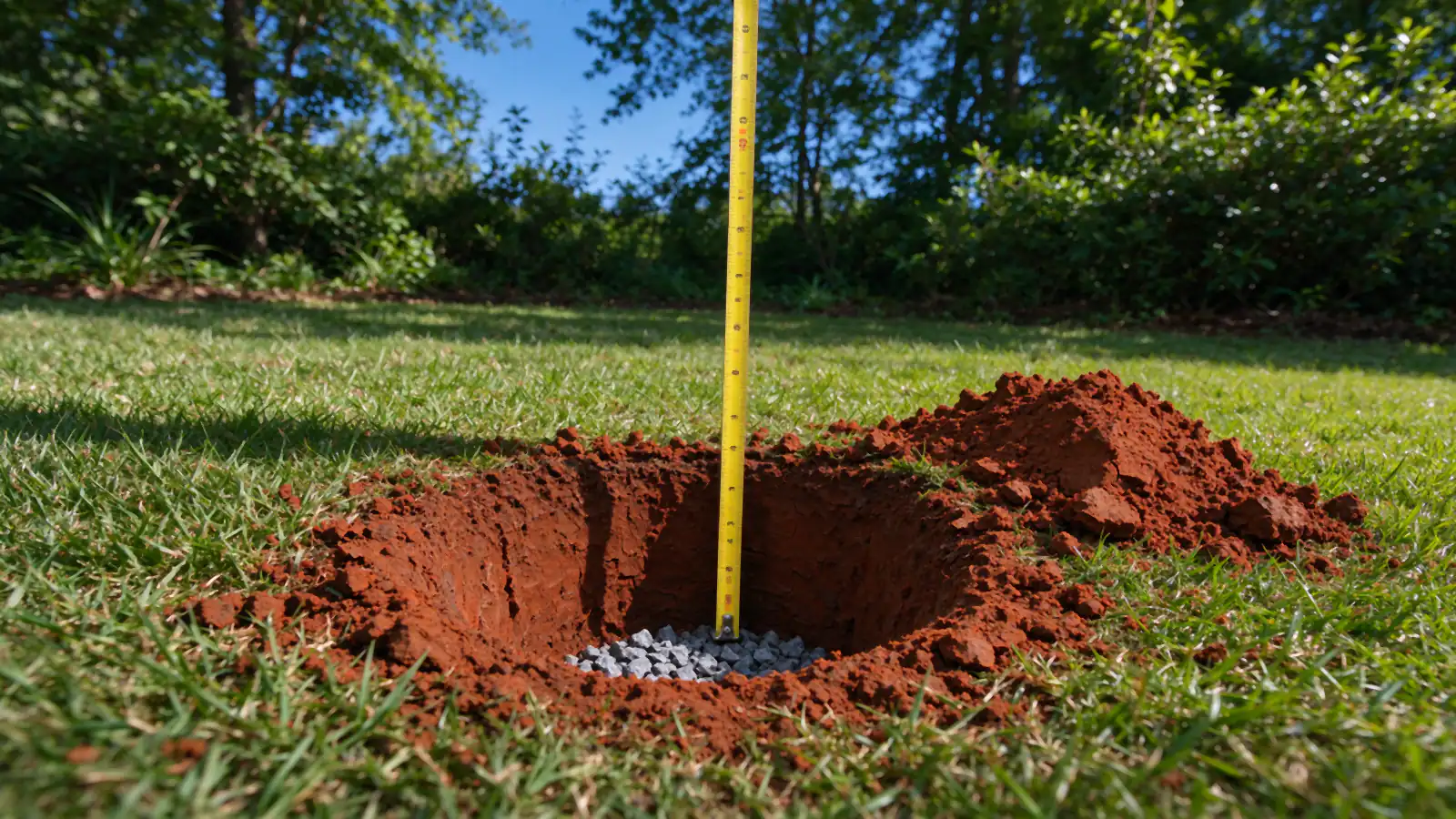
Deep enough to resist the load the fence puts on them. A common starting point is to bury roughly a third of the post’s total length, then go deeper for tall or solid fences, gate and corner posts, soft or wet soil and exposed lots. Posts on one fence are rarely all the same depth: a gate hinge post carries far more than a line post in the middle of a run, and it is set accordingly.
Upright Johns Creek Fencing sets posts for fence installation across north Fulton, where clay subsoils, stony ground and creek bottoms all show up on the same street. This guide explains how depth is decided.
What a post actually resists
A fence post works like a lever. Wind pushing on the boards, a dog leaning on the fabric, a gate hanging off one side: all of it tries to rotate the post around a point below grade. The soil in front of and behind the buried part of the post pushes back. The deeper and wider the footing, the more soil resists and the less the post moves.
That is why a 6-foot board-on-board privacy fence needs more than a 4-foot picket fence. The privacy fence is taller, so wind has a longer lever, and it is solid, so the wind has more area to push. An open fence like chain link or aluminum lets air through and loads its line posts far less.
Height and fence type
As the fence gets taller, the post gets longer and more of it goes into the ground. Solid wood and vinyl privacy fences catch the most wind. Shadowbox lets some air through. Picket, aluminum and chain link are open. An 8-foot privacy fence, where allowed, gets heavier posts, closer spacing and deeper footings than a 6-foot one. The privacy fence page explains the wind load on solid fences.
Manufacturers of vinyl, aluminum and chain link systems publish post sizes and setting depths for their products. Those are followed as a minimum, and adjusted for site conditions.
Gate, corner and end posts
Gate posts carry the weight of the gate cantilevered off one side, plus the force of every swing and slam. They are larger than line posts and set deeper, with a wider footing. A wide or heavy gate may call for a steel post. Corner and end posts carry the pull of the rails or, on chain link, the tension of the fabric, so they are also heavier and deeper. The sagging gate guide shows what happens when a hinge post is undersized.
Soil in north Fulton
The soils around Johns Creek are mostly Piedmont types with clayey subsoils. Firm clay holds a post well when it is dry, but it drains slowly, and wet clay is weaker. Some lots sit on stony soils where an auger stops short; others near creeks sit on bottomland soils that stay damp and flood occasionally.
Each condition changes the setting:
- Firm clay: good bearing, but each hole gets a gravel base so water drains away from the post.
- Soft, wet or fill soil: deeper and sometimes wider holes, because the soil resists less.
- Stone: the hole is finished with a rock bar or breaker, shifted along the line, or set in a wider footing designed for the load.
- Creek bottoms and swales: deeper posts and drainage, and a look at whether the fence will sit in moving water during storms.
Before any of those holes are dug with a powered auger, Georgia law requires a Georgia 811 locate request; the 811 guide covers the timing.
Frost depth
In cold climates, posts must reach below the frost line so freezing soil does not lift them. The local building code sets the minimum footing depth for structures, and the building department can confirm the figure for your address. For most fences in this area, wind load and soil strength, rather than frost, end up deciding the depth.
Hole width, gravel and concrete
Depth is only half the footing. The hole is usually several times the post’s width so there is enough concrete around it to spread the load into the soil. For wood posts, the bottom of the hole gets a layer of gravel, and the post sits on the gravel, not on concrete, so water can drain away from the end grain. Concrete fills around the post and is brought slightly above grade, then crowned so rain runs off rather than collecting against the wood.
Metal posts for aluminum, steel and chain link are set in concrete as well. Some systems use driven posts instead, mostly for farm and horse fencing, where tamped soil and the post’s own shape hold it.
Slopes and posts
On a slope, the downhill side of each post has less soil in front of it. Posts on a grade are often set a little deeper to make up for that. Stepped sections also put more load on the post at each step, where the fence changes height. The slope guide explains racking and stepping.
Signs a post was set too shallow
- The post rocks when pushed at the top.
- The fence leans in the direction of the prevailing wind or downhill.
- A gate drags or no longer latches.
- Concrete footing has lifted out of the ground on one side.
A post that is starting to lean can often be reset or replaced on its own. The leaning post guide covers the options, and fence repair covers the work.
How depth fits the estimate
Depth affects cost through digging time, concrete and, on rocky lots, extra equipment. It also affects how long the fence lasts; the wood fence lifespan guide explains why the post base is where wood fences fail. The fence cost guide shows how a full estimate adds up. Questions about a specific yard can go to the number at the top of the page or the form below.