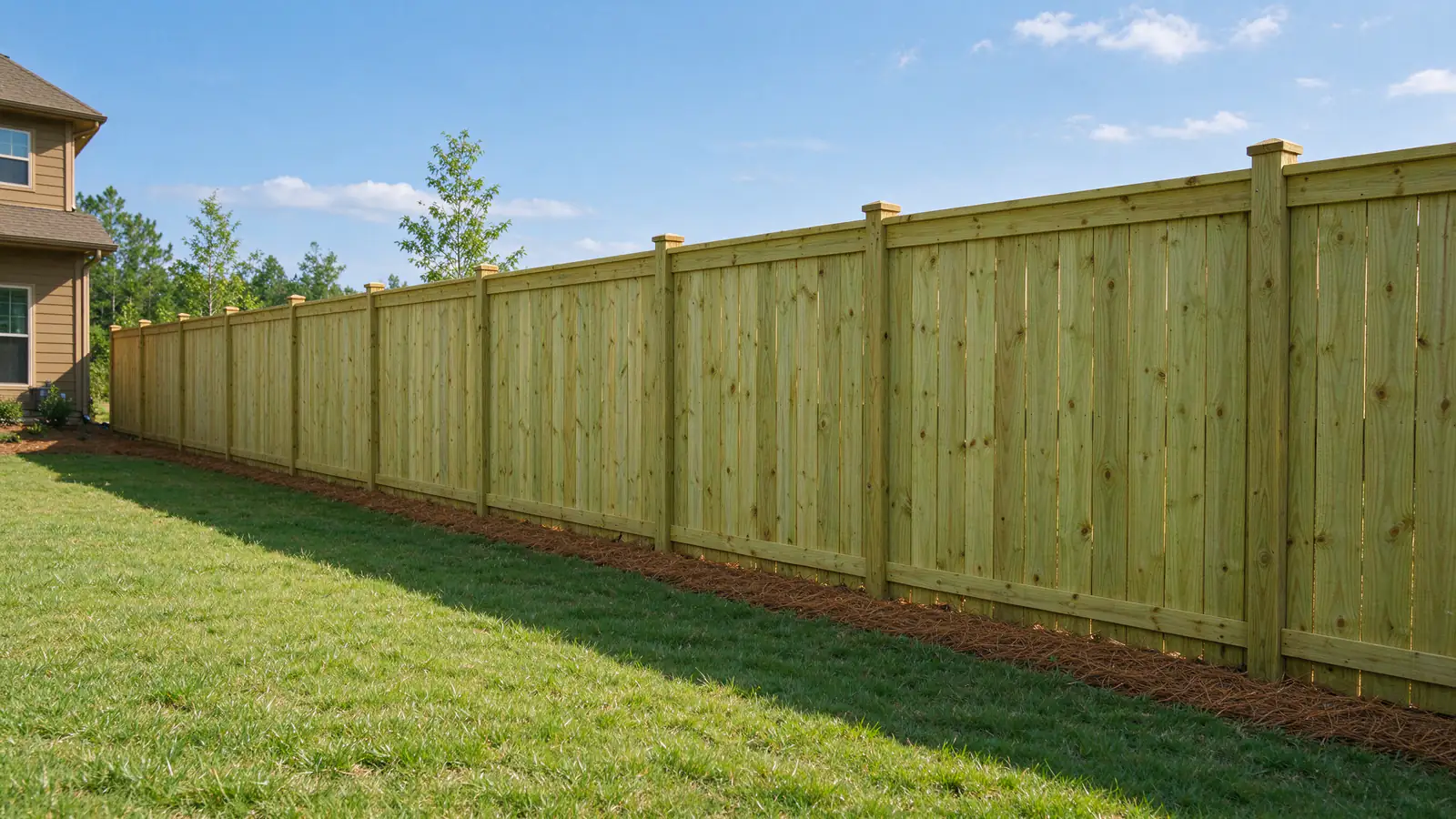
Upright Johns Creek Fencing installs wood fences across Johns Creek and north Fulton, from 6-foot privacy fences on rear lot lines to picket fences along front gardens, with the work done by licensed and insured fencing contractors. Wood is the most common fence material in Johns Creek backyards: it costs less to install than vinyl or aluminum, it can be repaired one board at a time, and it is what most HOAs expect on a rear property line.
How long a wood fence lasts here is decided mostly by what happens below the boards. The posts meet wet clay, mulch and termites at the soil line, and that is where wood fences fail. A wood fence built to last is built from the posts up.
What happens on the first visit
The visit walks and measures the line, marks corners and gates, and checks the grade where the yard falls toward a creek or swale. It covers the style and height your HOA allows, which side of the fence will face the neighbor, and how the fence handles any slope. Trees close to the line are noted, both because roots change where posts can go and because protected trees in Johns Creek need city permission to remove.
The estimate lists the posts, the style, the height, the gates and the Johns Creek permit, with tear-out of any old fence as a separate line.
Posts built for clay and termites
Wood fence posts fail at the soil line. On clay subsoil, a hole filled with plain soil holds water around the post after every rain, and the wood stays wet exactly where decay and termites do the most damage. Posts are rated for ground contact, set on a gravel base so water drains away from the bottom, and finished with concrete crowned above grade so water runs off rather than collecting against the wood. Mulch and soil are kept off the bottom of the fence, and sprinklers are aimed away from the boards.
Post size and depth follow the fence. A 6-foot solid privacy fence catches far more wind than a 4-foot picket, so its posts are heavier, deeper and closer together. Corner, end and gate posts carry more load and are set accordingly. The post depth guide explains how those decisions are made on Piedmont soils and stony ground.
Pine or cedar
Pressure-treated southern yellow pine is the standard fence lumber here. Treatment protects it from decay and insects, and it takes stain well once it has dried. Cedar resists decay naturally, is lighter and more stable, and weathers to a silver gray if left unstained; it costs more. Many fences combine the two, with treated posts in the ground and cedar boards above.
Fasteners matter with treated lumber, because the treatment chemicals corrode ordinary steel. Hot-dip galvanized or stainless fasteners are used so boards do not loosen and stain around rusting nails.
Choosing a style
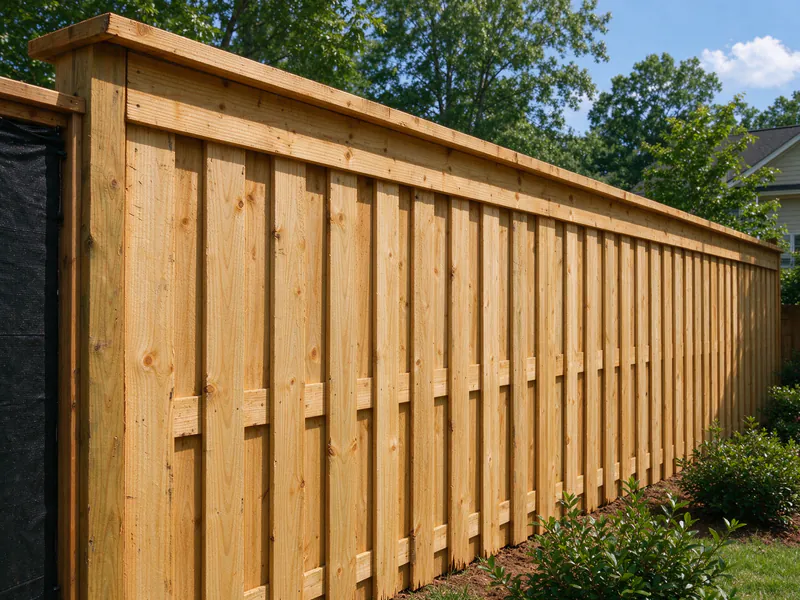
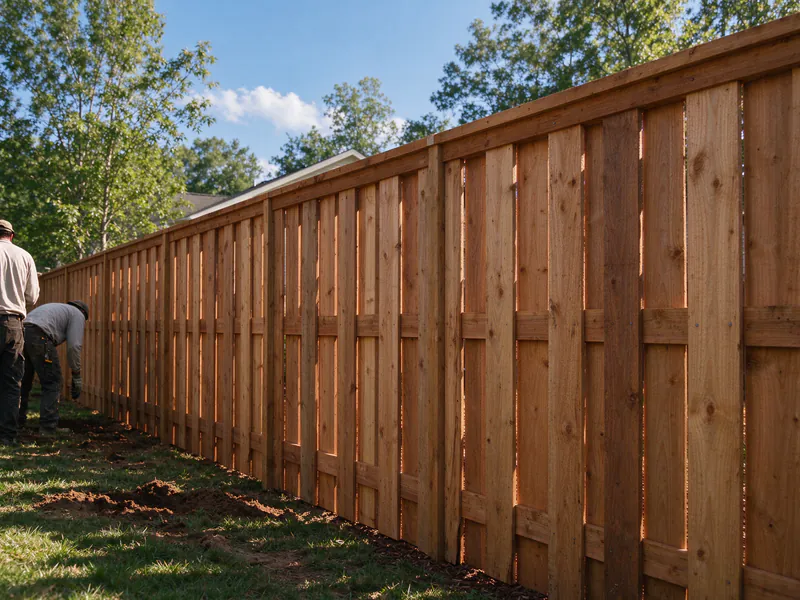
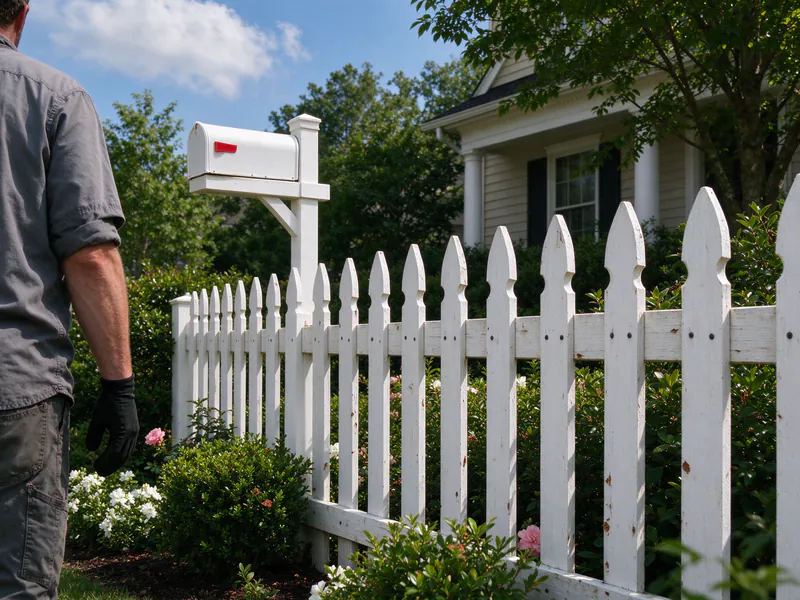
Board-on-board overlaps boards on one side of the rails, so there are no gaps even after the wood shrinks. It gives the most privacy and catches the most wind. Shadowbox alternates boards on each side of the rails; it looks the same from both yards, lets some air through and you can see through it at an angle. Stockade is the simplest privacy style, with boards side by side, and gaps open as the boards dry. Picket fences mark a boundary rather than screen a yard and suit front gardens.
The Johns Creek zoning code calls for the finished side of a fence along a property line to face the neighboring property (confirm with the city). Board-on-board and shadowbox look finished from both sides, which is one reason they are popular on shared rear lines. The board-on-board vs shadowbox guide compares them in detail, and the privacy fence page covers height and wind.
Gates in a wood fence
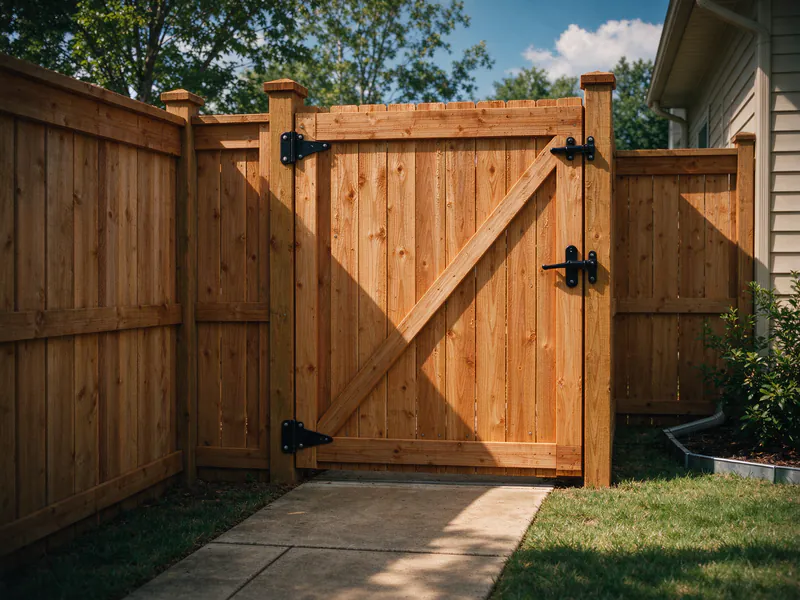
Wood gates sag when they hang on undersized posts or have no brace. Each gate gets hinge and latch posts set deeper than line posts, a diagonal brace that runs from the bottom of the hinge side up toward the latch side’s top corner so it holds the gate up, and hardware rated for the gate’s weight. Wide openings use double gates with a drop rod and stop, and very wide or heavy gates may need a steel post or frame. More on gates is on the gate installation page.
Staining and upkeep
New treated lumber is often wet from treatment, so stain is applied once the wood can absorb it, frequently a few months after installation. After that, a stain every few years protects the boards from sun and water and keeps the color even; fences in full sun need it more often than fences in shade. Stain protects boards; it cannot fix a post that is already soft. The staining page and the guide to when to stain a new fence cover timing and products.
What a wood fence costs
A 6-foot wood privacy fence typically runs about $20 to $30 per foot installed in the Atlanta area, before gates, tear-out and the $75 Johns Creek residential permit. Board-on-board, 8-foot heights and cedar push toward the high end; long straight runs on easy ground sit toward the low end. The fence cost guide shows how a full estimate adds up, and the wood vs vinyl guide compares the long-term picture.
Wood on a sloped yard
Many Johns Creek backyards fall toward a creek or a drainage swale. Wood handles slopes well because it is built on site: rails can follow the grade so the fence racks smoothly, or sections can stay level and step down at each post. Racking keeps the bottom close to the ground, which matters for dogs; stepping keeps the top line level, which some HOAs prefer, but leaves triangular gaps under each section that may need a kickboard or a gravel strip. On steep grades, posts are longer on the downhill side to keep the fence at its full height. The slope guide compares both methods.