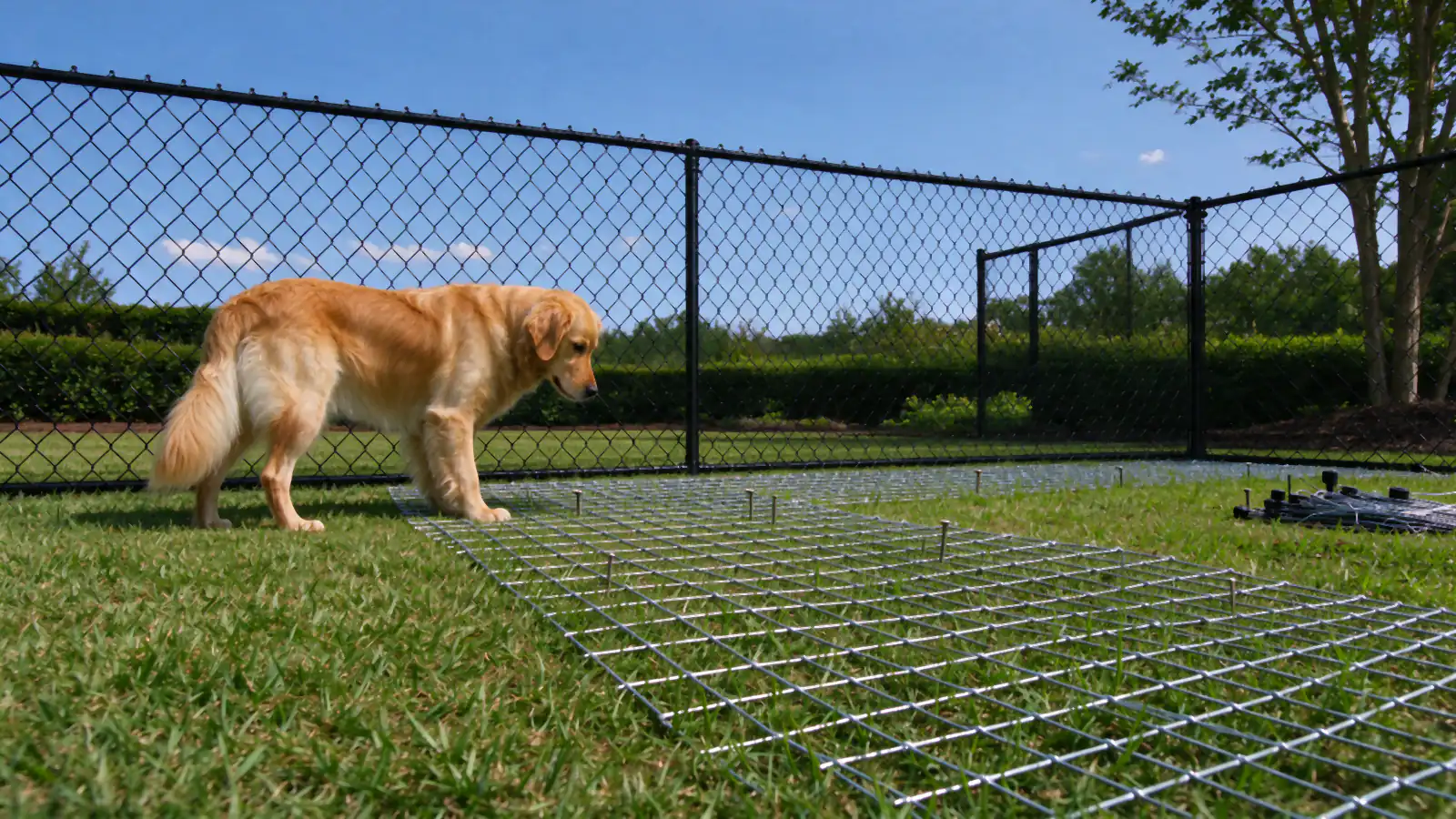
The best fence for a dog is the one built for how that dog gets out. Jumpers and climbers need height and a face with no footholds. Diggers need a barrier below grade along the bottom. Dogs that bark at everything that moves usually settle behind a solid wood or vinyl fence they cannot see through. Every dog needs gates that close and latch on their own, and no gaps under stepped sections on a slope.
Upright Johns Creek Fencing builds dog fences across north Fulton in wood, chain link and aluminum. This guide matches the fence to the dog.
Start with how your dog escapes
Most escapes fall into a few patterns, and each one points to a different detail:
- Over the top: jumpers clear low fences; climbers use rails, chain link mesh or a woodpile as a ladder.
- Under the bottom: diggers tunnel, and small dogs squeeze through gaps under stepped sections.
- Through the fence: small dogs slip between pickets; big dogs push loose boards or bent fabric.
- Through the gate: gates left open, gates that do not latch, and gaps at the hinge side.
If your dog has escaped before, the route it used tells you where to spend money.
Jumpers and climbers
Height matters most for jumpers. Most backyard fences are 4 to 6 feet tall; athletic breeds usually need the 6-foot end. Johns Creek allows residential fences up to 8 feet, but HOAs often set lower limits, so check before planning above 6 feet. The Johns Creek permit guide covers the city rules.
Climbers use whatever gives them a foothold. A wood fence with its rails on the yard side is a ladder; turning the finished face toward the yard, or adding boards over the rails, removes it. Chain link mesh is easy for some dogs to climb, and smaller mesh helps. Aluminum’s vertical pickets give little to grip. An inward-angled extension or roller bar along the top stops determined climbers, where the HOA allows it.
Diggers
Dogs that dig usually work along the fence line, often in the same spot. A buried barrier along the bottom stops them. Common options are a strip of galvanized welded wire buried vertically or bent outward in an L along the bottom, a concrete mow strip, or a row of pavers. On chain link, a bottom tension wire holds the fabric tight to the ground so dogs cannot push under it.
On north Fulton’s clay soils, a dog digging along a wet fence line can undermine a post footing over time, so a barrier also protects the fence.
Barkers and fence-runners
A dog that barks at people, dogs or cars passing by often calms down when it cannot see them. A solid wood or vinyl privacy fence does that. Board-on-board blocks views completely; shadowbox is opaque head-on but see-through at an angle, which a fence-running dog will find. The board-on-board vs shadowbox guide explains the difference.
Open fences, like chain link and aluminum, let the dog see everything. Some dogs are content to watch; others run the line all day and wear a path in the grass.
Small dogs and puppies
Standard picket spacing on aluminum and many wood picket fences is wide enough for small dogs to slip through. Puppy-picket aluminum panels add extra pickets along the bottom. On wood fences, closer picket spacing or welded wire fastened along the bottom closes the gaps. Gaps under gates matter more for small dogs too. The aluminum vs steel guide covers ornamental options.
Large and strong dogs
Big dogs lean on fences, jump at them and hit them running. Posts set properly in concrete, rails fastened well and heavier fabric or thicker pickets hold up. On chain link, heavier gauge fabric resists bending. A wood privacy fence with its boards on the yard side resists pushing better than boards on the far side of the rails, because the dog pushes them into the rails rather than off them.
Slopes and gaps
Stepped fences on sloped yards leave a triangle of open space under the downhill end of each section. Dogs find those gaps quickly. Racking the fence to follow the grade, or filling each gap with a board, timber or buried wire, closes them. The slope guide explains both methods.
Gates
Gates are where most dogs actually get out. A gate for a dog yard should close on its own and latch on its own, with self-closing hinges and a gravity latch. A gate that sags drags on the ground and stops short of latching; the sagging gate guide explains why gates drop. Keeping the gap under the gate small, and the hinge-side gap narrow, matters for small dogs. A latch that can be locked keeps visitors and lawn crews from leaving it open.
Matching material to dog
| Dog | Usually works well | Watch for |
|---|---|---|
| Jumper | 6-ft wood privacy or aluminum | Rails or mesh used as footholds |
| Digger | Chain link with tension wire and buried barrier | Clay softening along the line |
| Barker | Board-on-board wood or solid vinyl | Shadowbox angles |
| Small dog | Puppy-picket aluminum or wood with tight spacing | Gaps under gates and steps |
| Large dog | Heavy-gauge chain link or well-built wood | Posts and fasteners |
Where the rules limit choices
Johns Creek does not allow chain link along streets in single-family subdivisions (confirm with the city), and many HOAs restrict it or limit fence height. Front yards often have lower height limits. Check before choosing, especially for a front-yard dog fence. The chain link vs wood guide compares those two common dog fences.
How to decide
Tell your installer how the dog gets out, how big it is, whether it digs and where it spends its time. The fence follows from that. The fence cost guide shows how extras like buried barriers and self-closing gates add up, and questions about a specific yard can go to the number at the top of the page or the form below.