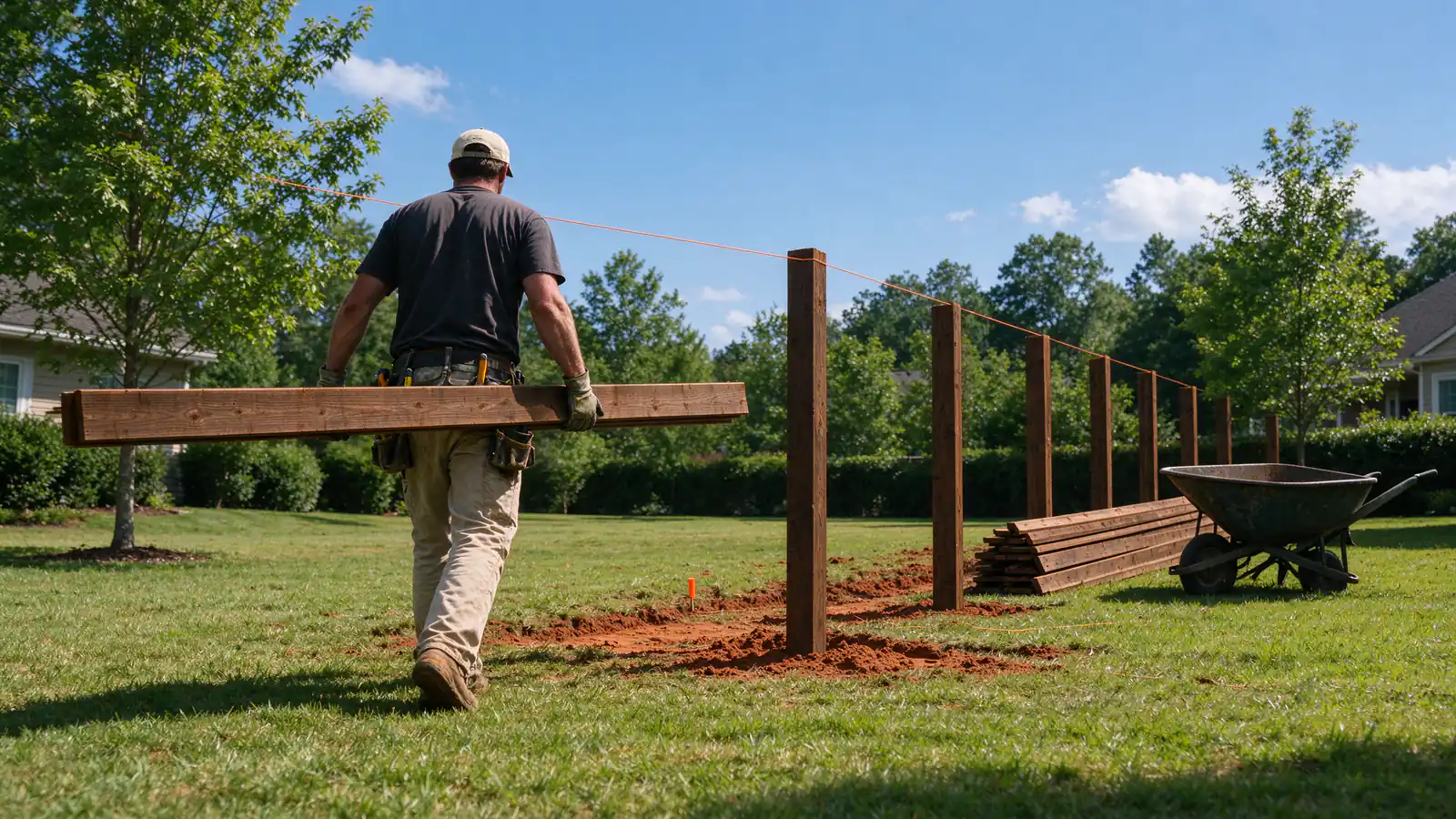
The build itself is usually the short part. On a typical Johns Creek job, most of the calendar goes to the steps before it: HOA review, the city fence permit and the Georgia 811 wait of at least 3 business days. The build then depends on the length of the fence, the number of gates, the ground and the weather. Special-order materials, like some aluminum styles and custom gates, can add lead time.
Upright Johns Creek Fencing handles each of those steps as part of fence installation across north Fulton. This guide walks through the sequence and what changes its length.
The steps in order
- Estimate visit: measure the line, mark gates and note slopes, trees and private utilities.
- Plat and site plan: the fence drawn on the lot survey.
- HOA approval, if the subdivision has an architectural committee.
- The city fence permit.
- Materials ordered and delivered.
- Georgia 811 locate request, at least 3 business days before digging.
- Tear-out of any old fence.
- Posts set in concrete.
- Rails, boards or panels and gates.
- Final walkthrough and cleanup.
Steps 3 and 4 usually take the most time, and they cannot be rushed from the installer’s side.
HOA review
Many Johns Creek subdivisions have an architectural review committee that must approve a fence before it goes up. Committees meet on their own schedule, some monthly, and an incomplete application can push approval to the next meeting. Submitting a clear site plan and a picture or drawing of the style the first time is the best way to avoid delay.
The city permit
Johns Creek requires a fence permit for new and replacement fences, applied for through the city’s online portal with a site plan. Review times vary with the city’s workload and how complete the application is. Nearby cities have their own processes; the service area pages cover each one.
The 811 wait
Before digging with a powered auger, Georgia law requires a Georgia 811 locate request and a wait of at least 3 business days for utilities to mark their lines. A normal request lasts 30 calendar days after its effective date, so it is placed close to the installation date, after approvals are in hand. If rain pushes the job past 30 days, a new request is needed.
Materials
Pressure-treated pine, chain link and common aluminum styles are usually easy to get. Cedar, some vinyl colors and profiles, specific aluminum panels, custom gates and gate operators can take longer. Ordering is usually done once the HOA has approved the style, so the approved product is the one delivered.
Tear-out
Removing an old fence adds time, especially when old posts were set in concrete and the footings have to come out or be worked around. Tear-out and disposal are priced separately; the fence replacement page covers the work.
Setting posts
Posts are the most important step and the slowest per foot. Holes are dug, each gets a gravel base, posts are set plumb and aligned on a string line, and concrete is placed around them. Rocky ground slows digging; wet clay may mean waiting for holes to drain. Some crews finish a fence in one continuous visit and others let concrete set before hanging rails and gates, depending on the system and the weather. The post depth guide explains why posts get this much care.
Building the fence
Once posts are set, the fence goes up quickly. Wood fences get rails, then boards, then trim. Vinyl and aluminum panels slide or bolt into the posts. Chain link gets its framework, then fabric stretched and tied. Gates are hung last and adjusted to swing and latch. Longer runs, more gates, slopes and board-on-board styles all add time.
Weather
Heavy rain stops digging and post-setting, and saturated clay can delay work for a day or more after it ends. Summer heat slows crews in the afternoon; thunderstorms are common. Wind matters for setting large panels. Most delays are short, but a wet stretch can shift a schedule.
After installation
New pressure-treated pine is wet when installed and needs time to dry before staining. The new fence staining guide covers timing. Concrete around posts keeps curing after the crew leaves, so avoid hanging heavy items or letting large dogs lean hard on the fence right away.
How to keep the timeline short
- Find your plat early; a survey takes time if the corners are uncertain.
- Submit the HOA application complete the first time.
- Mark private lines, such as irrigation and dog fence wire, before the estimate.
- Decide gate locations and widths before ordering.
- Clear the fence line of plants, stored items and debris.
The fence cost guide covers what the estimate includes. Questions about a specific yard can go to the number at the top of the page or the form below.