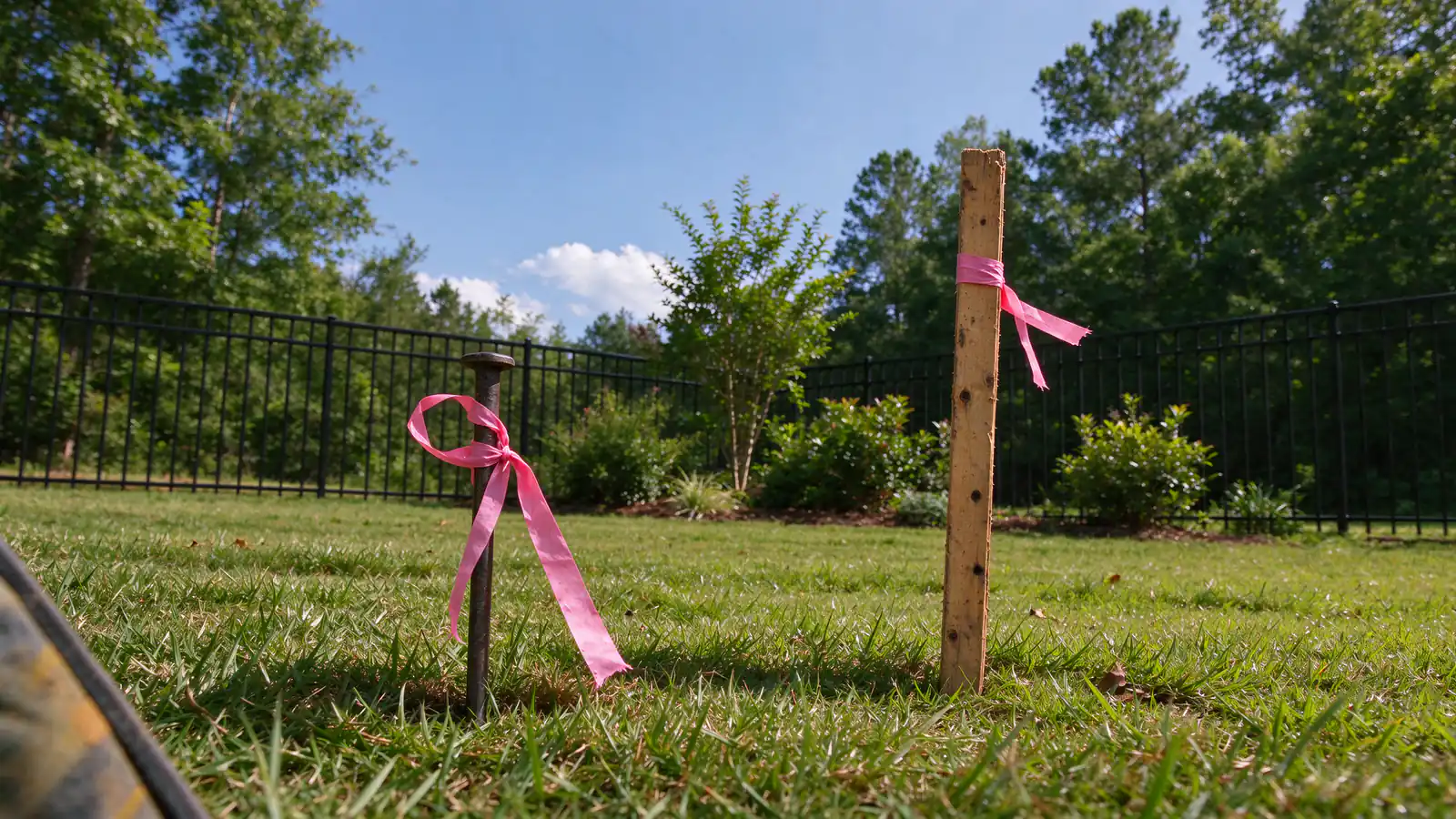
Not every fence needs a new survey, but most fences built on or near a property line in Johns Creek benefit from one. If the fence will sit a few feet inside your line, the recorded plat and pins you can find are usually enough. If it will sit close to the line, follow a disputed line, or replace an old fence of uncertain placement, a licensed surveyor should locate the corners first.
Upright Johns Creek Fencing plans fences from the plat and the pins on the ground, and recommends a survey when the line is close or uncertain. This guide explains how to tell which situation you are in.
What the plat shows
A plat is the recorded drawing of a subdivision or lot. It shows the lot’s boundary lines with their lengths and bearings, the street right-of-way, building setbacks, and easements for drainage and utilities. In Johns Creek, copies of final location plats are on file for many, though not all, homes, and you request one from the City Clerk’s Office through a Request for Public Records using the street address or parcel number. The city does not accept faxed plats for permits, because faxing distorts them.
For a Johns Creek fence permit, the plat is usually the base of the site plan: the fence is drawn on it with its height, material and gates.
What the plat does not do
A plat does not put anything on the ground. To place a fence from a plat, you need to find the corners it describes, usually iron pins or pipes set when the subdivision was built. Pins are often a few inches below the surface, and they get bent, pulled or buried during construction, landscaping and driveway work. A pin you find may not be where it was set, and a metal object in the right area may not be a pin at all.
That is the gap a survey fills. A licensed surveyor locates the corners from recorded data and nearby monuments, confirms or resets the pins, and can flag the line between them.
Why an old fence is not the line
Many wood fences in Johns Creek subdivisions were built when the houses were new, sometimes by builders and sometimes by owners working from a guess. Some went in a foot inside the line to leave room; others went a few inches over. Trees, slopes and swales pushed some lines off course. Replacing an old fence in the same holes repeats whatever mistake was made. Before a replacement along a shared line, the plat is checked against what is on the ground, and a survey is recommended when they do not agree.
When a survey is worth it
A survey is worth its cost when:
- The fence will sit on or within a foot or two of the property line.
- You and a neighbor disagree about where the line is.
- The old fence looks out of line with the plat or the house setbacks.
- Pins are missing, bent or inside landscaping where they may have moved.
- The lot is irregular, on a curve or a cul-de-sac, where small errors grow over distance.
- The fence runs along an easement edge, where being on the wrong side matters.
A survey is usually not needed when the fence will sit well inside the line, the pins are clearly found and undisturbed, and no neighbor disputes the placement. Building a few inches inside the line also leaves room to maintain both sides of the fence from your own property.
Neighbors and shared lines
In Johns Creek subdivisions, rear and side lines are often shared with two or three neighbors. Talking to them before the fence goes up avoids most problems: where the fence will sit, which side faces them, and whether an old fence will come down. The Johns Creek zoning code calls for the finished side of a fence along a property line to face the neighboring property (confirm with the city); the finished side guide covers what that means.
If a neighbor disputes the line, a survey settles the facts. A fence contractor should not represent a guess as a survey, and a fence built on a guess can end up being moved at the owner’s cost. The cost guide shows how a survey fits into a fence budget.
Easements and setbacks on the plat
The plat also shows easements, typically drainage and utility strips along rear and side lines. A fence inside an easement may have to come out if the easement holder needs access. The easement guide explains the risks. Building setbacks on the plat do not usually apply to fences, but the zoning code keeps fences 3 feet off a public right-of-way in Johns Creek (confirm with the city).
What a survey costs and how long it takes
Survey fees vary by lot size, how easy the corners are to find, and how much work the surveyor has to do to tie into recorded monuments. There is no public price figure; surveyors quote per job. Plan for some lead time, since a surveyor’s schedule can affect when the fence permit and installation happen. A pin-and-flag job for a fence is usually simpler than a full boundary survey with a new drawing.
Putting it into the plan
On a typical Johns Creek job, the plat is pulled first, the pins are looked for on the first visit, and the fence line is laid out from them. When the pins are missing, the line is close, or a neighbor disagrees, a survey is recommended before the site plan goes to the HOA and the city. Questions about a specific lot can go to the number at the top of the page or the form below.