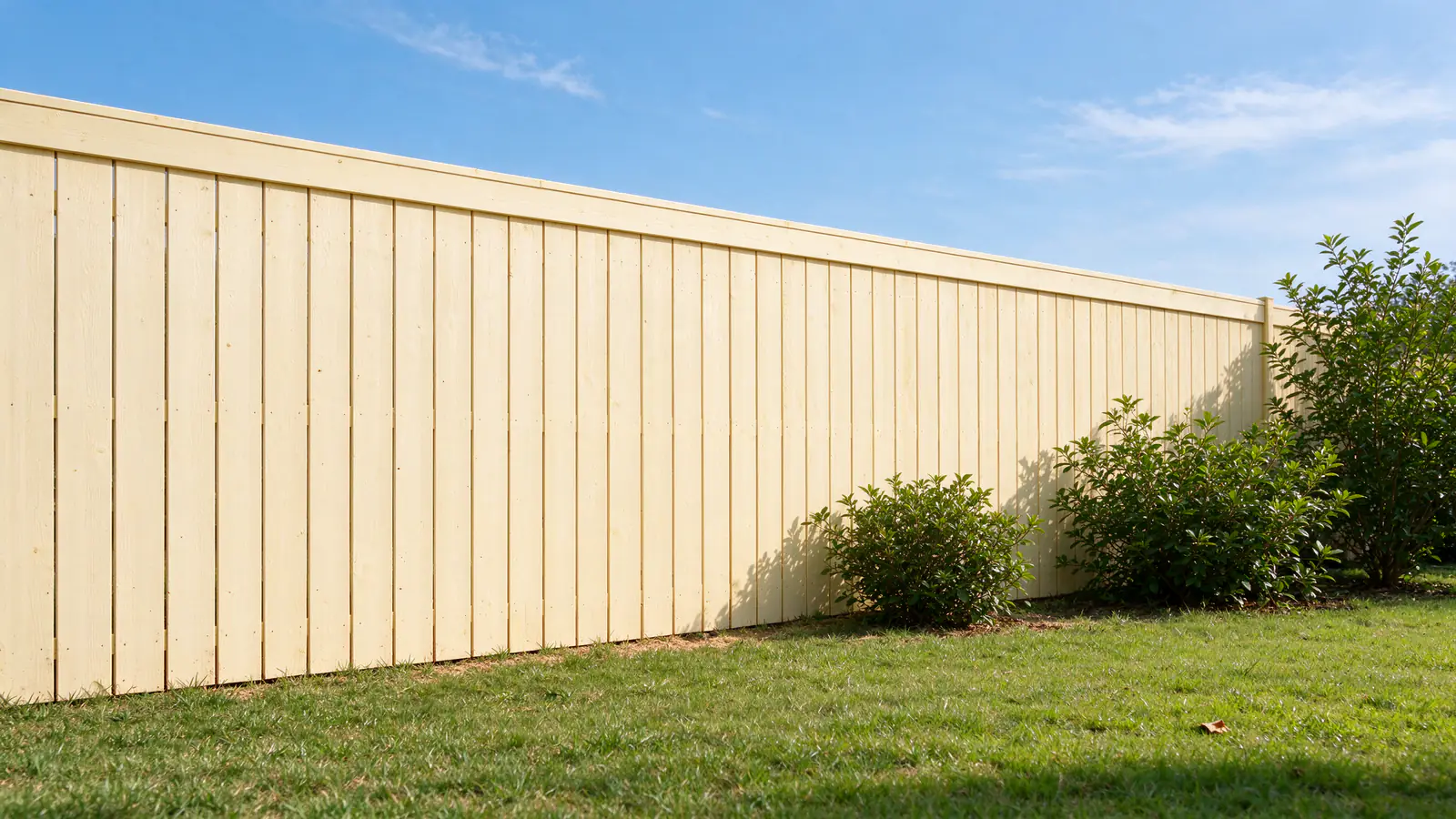
The finished side faces out, toward the neighboring property and the street, with the posts and rails on the owner’s side. The Johns Creek zoning code says fences along property lines are built with the finished side toward the neighboring property (confirm with the city), and Sandy Springs and Peachtree Corners have the same rule in their own codes.
Upright Johns Creek Fencing builds every fence to the finished-side rule that applies at the address. This guide explains what “finished side” means, how the rules read in nearby cities, and which styles make it a non-issue.
What the finished side is
On a typical wood privacy fence, posts are set in the ground, horizontal rails run between them, and boards are attached to one face of the rails. That face is the finished side: smooth boards from end to end. The other side shows the posts, rails and fasteners. Panel fences in vinyl or composite usually have a front and back as well, and aluminum fences often have a rail side.
What the codes say
Johns Creek’s zoning code section on fences and walls requires fences along all property lines to be built with a finished side toward the neighboring property (confirm with the city for your lot).
Sandy Springs’ development code requires walls and fences to be built with the finished side facing the street and adjoining properties, away from what the fence screens. Peachtree Corners’ residential fence guidelines say the finished side should face out and the unfinished side inward toward your property.
So in all three, the neighbor and the street see the good side. Where a city’s rule is not published, HOAs commonly require the same.
Why the rule exists
The finished-side rule keeps the street and the neighborhood looking consistent, and it puts the structure on the owner’s side, where the owner can maintain it. It also settles an awkward question between neighbors before it starts: nobody gets stuck looking at the back of someone else’s fence.
Styles that look finished from both sides
Several common styles look finished from both sides, which makes the rule easy to meet and tends to please neighbors on shared lines:
- Board-on-board overlaps boards on alternating sides so both faces look like a solid board fence.
- Shadowbox alternates boards on each side of the rails, so the fence looks the same from both yards.
- Good-neighbor panels in vinyl hide the rails inside the panel.
- Aluminum looks nearly the same from both sides.
The board-on-board vs shadowbox guide compares the two most common wood options.
Corner lots and streets
On a corner lot, the fence faces streets on two sides and neighbors on the others. The finished side faces outward on every side. Corner lots also have height limits on the street side in many cities; Peachtree Corners, for example, limits the corner side to 6 feet in line with the house and 4 feet between the house and the right-of-way. Sight distance near the intersection keeps fences low there too.
Shared fences and neighbors
On a shared rear line, the fence belongs to whoever builds it on their side of the line, and the finished side faces the neighbor. If neighbors are sharing the cost of one fence on the line, agreeing on a style that looks good from both sides avoids disagreement. Placing the fence a few inches inside the line, after confirming it with a survey where needed, lets the owner maintain both faces.
What HOAs add
Many HOAs repeat the finished-side rule and may specify a style that is finished on both sides. Some also specify which side of a gate faces the street. The HOA approval guide covers what committees ask to see, and the Johns Creek permit guide covers the city’s other fence rules.
Building it right the first time
The finished side is decided at layout, because rails are attached to the posts on the inside and boards go on the outside. Turning a finished fence around later means rebuilding it. Showing the finished side on the site plan for the HOA and the city avoids that. A wood privacy fence in board-on-board or shadowbox is the simplest way to meet every version of the rule. Questions about a specific line can go to the number at the top of the page or the form below.
Gates and the finished side
Gates follow the same rule as the fence: the finished face goes toward the street or neighbor, with the frame and brace on the owner’s side. On a gate, that also puts the diagonal brace where it can be inspected and the hinges where they can be adjusted. A gate built with its brace facing out is usually a sign it was turned around after the fact. More on gate frames is on the gate installation page.
Replacing a fence that faces the wrong way
Older fences in north Fulton were sometimes built with the rails facing the neighbor. Replacing one is the time to turn it around so it meets the current rule. Because the finished side depends on which side the boards are attached to, this is decided when the new posts are set; the fence replacement page covers the process.