A fence entirely behind the house
Dunwoody does not require a fence permit when the fence is completely to the rear of a residential home, though it must still meet the zoning ordinance.
Service area
Fences in Dunwoody, GA: no permit for fences fully behind the house, quick permits for front and side fences, street-yard height limits and typical prices.
Last Updated:
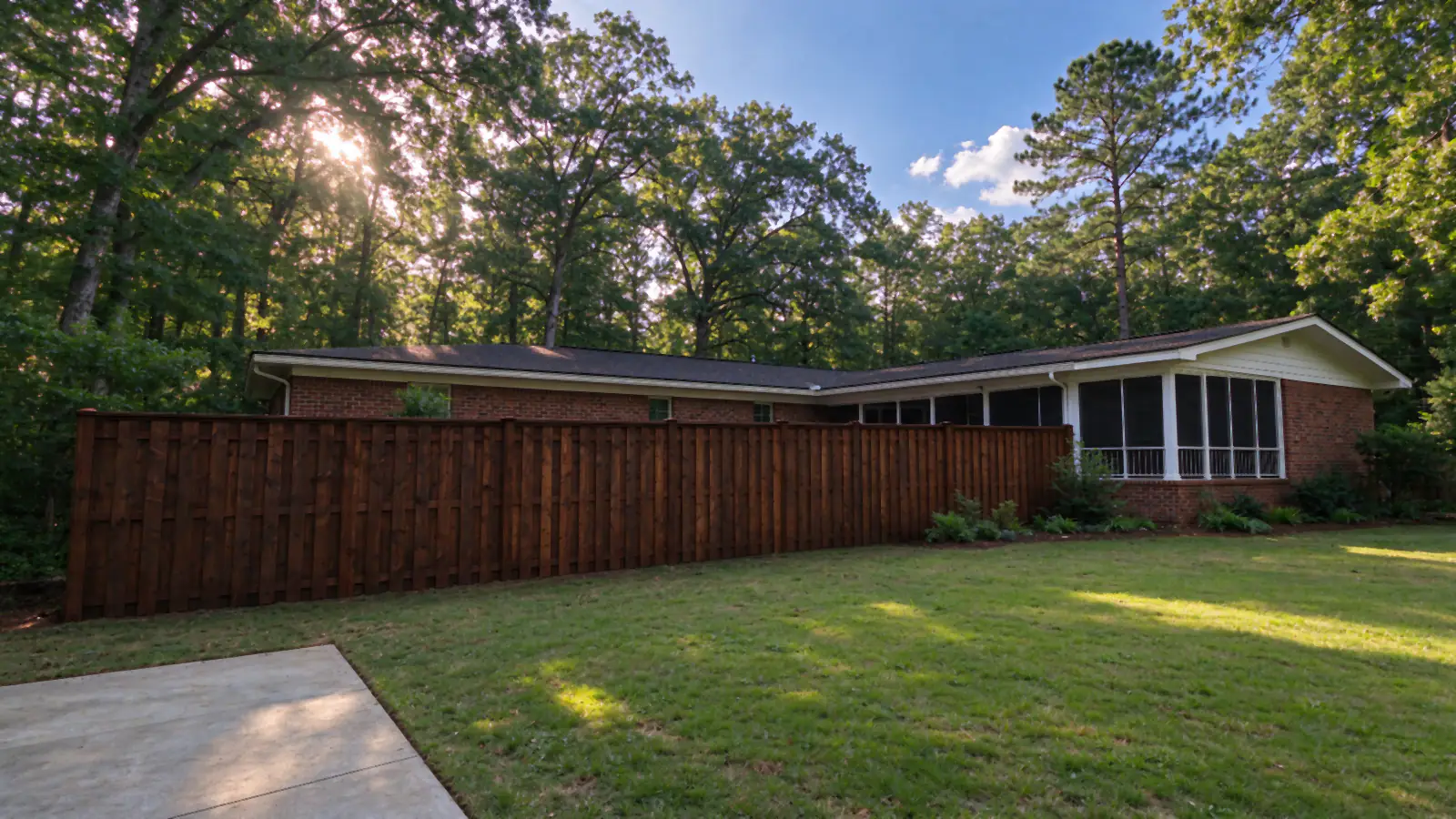
Dunwoody does not require a fence permit when the fence is completely to the rear of a residential home, though it must still meet the zoning ordinance.
Fences outside the rear of the house need a permit. The city says there is no fee and residential fence permits are typically issued in 1 to 3 business days.
Street-yard fence heights depend on the type of road; the city's application allows up to 8 feet along collector and arterial streets (confirm with the city).
Summaries say replacement fences in front yards, on corner lots or in stream buffers need a permit (confirm with the city).
Behind the back wall of a Dunwoody house, a new fence usually needs no permit at all; in front of it, the city issues one for free, often within a few business days. Upright Johns Creek Fencing installs fences and gates in Dunwoody, inside I-285 south of Johns Creek, with licensed and insured fencing contractors on the job. Dunwoody draws a clear line on fence permits: a fence completely to the rear of a house needs none, while fences elsewhere on the lot go through a permit that the city says is free and usually issued within a few business days. Heights along the street depend on what kind of road the lot faces. The city’s own fence permit page is the source for the permit rules; the height rules come from summaries of the zoning ordinance and the city’s application, so confirm them with Dunwoody Community Development.
The City of Dunwoody says a fence permit is not required when a fence is completely to the rear of a residential home. The fence still has to meet the zoning ordinance. That covers most backyard privacy fences, which run from the back corners of the house along the side and rear lot lines. A fence that comes forward of the back of the house, wraps a side yard toward the street or sits in the front yard needs a permit.
For fences that do need one, the city says there is no fee, and residential fence permits are typically issued within 1 to 3 business days. Summaries add that permits are required for new fences, vehicular gates, and replacement fences in front yards, on corner lots or within stream buffers. That is quicker and cheaper than Johns Creek, where every new and replacement fence needs a $75 permit, and lighter than Sandy Springs, with its detailed design rules.
Street-yard heights are where Dunwoody gets specific. Summaries of the zoning ordinance put fences in any street yard on a residential lot at 4 feet, with corner lots allowed 6 feet on the side street through an administrative permit. The city’s application allows fences up to 8 feet in the street yard of a residential lot that faces a collector or arterial street, where traffic noise and headlights make taller screening reasonable. City Council has also debated limiting fence and wall heights in single-family areas. Because the rules depend on your road and lot, confirm the limit with the city before ordering materials.
Much of Dunwoody was built as single-family subdivisions with large trees, and many lots have older fences that are reaching the end of their lives. Replacing a fence here is a chance to check the line against the plat, route posts around tree roots rather than cutting them, and set new posts in undisturbed ground with drainage under each footing. The fence replacement page covers tear-out and haul-away, and the survey guide explains when to locate the pins.
Dunwoody is crossed by creeks and has wooded stream corridors, including around the Dunwoody Nature Center and Brook Run Park. Fences near streams can fall inside protected buffers, and summaries say replacement fences in stream buffers need a permit. Ground near creeks is often soft and wet, which affects footings. Check with the city before clearing a line or replacing a fence near a stream.
Vehicular gates need a permit in Dunwoody, according to summaries. Driveway gates are placed with room for a car to pull off the street, and gates in a fence line hang on posts sized for them so they stay square. See the gate installation page and, for automated gates, the automatic gate page.
Dunwoody jobs are split at the back wall of the house. Everything behind it can usually be built without a permit; anything forward of it, along a side street, or across the driveway goes through the city’s free permit, which normally takes a few business days. The drawing shows which sections are which and the street-yard heights that apply to your road. With the HOA’s approval and any permit in hand, the 811 request is placed three business days ahead of auger work. Posts are set around tree roots where needed, the infill goes up after the footings cure, and gates are hung and adjusted last.
Many Dunwoody homes are ranches and split levels on lots that fall away behind the house, so backyard fences often step down toward the rear line. Stepped wood sections leave triangles under each panel that need a kickboard where a dog lives; racked sections follow the grade without gaps. Split-level lots also tend to have retaining walls or terraces near the house, and fences are set back from the top of a wall rather than on it unless the wall was built to carry one.
Rear-yard privacy fences in wood are the most common, often 6 feet, with board-on-board or shadowbox giving a finished face to neighbors on shared lines; the finished side guide explains why. Front and side-street fences, where heights are lower, suit aluminum or picket styles. Pool barriers follow the state pool and spa code with the pool’s permit.
Dunwoody charges nothing for a fence permit, so a budget is the fence itself plus gates and removal. As a planning guide, metro Atlanta installations of 6-foot wood privacy run about $20 to $30 per foot, vinyl about $20 to $40 and aluminum about $25 to $50. Wooded lots where posts must dodge roots, older fences with deep concrete footings to pull, and creek-side ground tend to push a job toward the upper end. The fence cost guide has worked examples.
Brick ranches and traditional homes are common in Dunwoody, and fences that suit them tend to be simple: board-on-board or shadowbox wood in the back, picket or black aluminum in front where the street-yard height allows. Stain colors that echo the brick or trim tie the fence to the house.
Planning a fence in Dunwoody?
Send the address and the rough length; the rules for that lot come first.
Not if the fence is completely to the rear of the house. The City of Dunwoody says a fence permit is not required in that case, but the fence must still meet the zoning ordinance.
The city says residential fence permits are typically issued within 1 to 3 business days, and there is no fee for a fence permit.
It depends on the road. Summaries of the zoning ordinance put street-yard fences at 4 feet on most residential streets, and the city's application allows up to 8 feet along collector or arterial streets. Confirm with the city for your lot.
Typical Atlanta-area ranges apply: about $20 to $30 per foot installed for 6-foot wood privacy, $20 to $40 for vinyl and $25 to $50 for aluminum, before gates and tear-out. Dunwoody charges no fee for a fence permit.
Summaries of the city's rules say replacement fences within stream buffers need a permit, along with front-yard and corner-lot replacements. Ask the city before working near a creek.
Send the rough length, the material you are considering and whether an HOA or pool is involved. Photos of the yard help.
Upright Johns Creek Fencing
office@uprightjohnscreekfencing.com
11340 Lakefield Dr, Johns Creek, GA 30097
Monday to Friday 8 AM to 6 PM; Saturday and Sunday 9 AM to 2 PM
Outside these hours, emergency calls only
Photos of the fence line, the corners and any gates help most.