Printable checklist
Johns Creek fence planning checklist
For anyone planning a new or replacement fence or gate in Johns Creek and north Fulton. It lists what to settle before anyone digs: where the line is, what the HOA and the city need, Georgia 811, and what to ask every estimate to spell out.
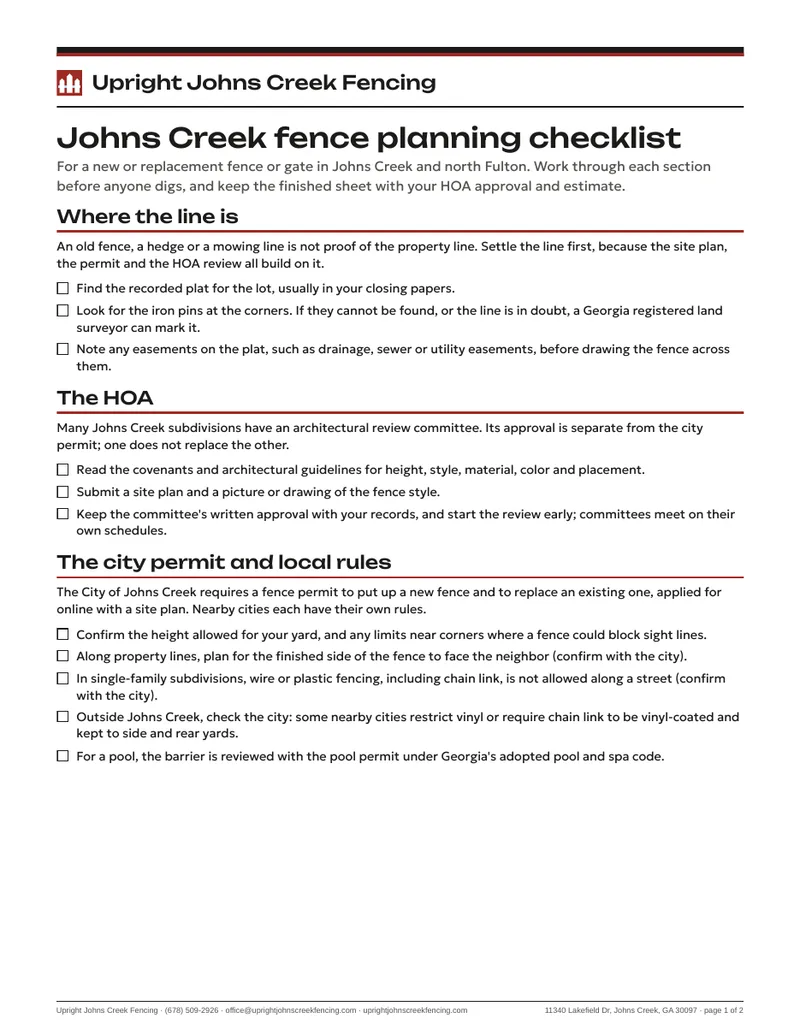
What the checklist covers
Where the line is
An old fence, a hedge or a mowing line is not proof of the property line. Settle the line first, because the site plan, the permit and the HOA review all build on it.
- Find the recorded plat for the lot, usually in your closing papers.
- Look for the iron pins at the corners. If they cannot be found, or the line is in doubt, a Georgia registered land surveyor can mark it.
- Note any easements on the plat, such as drainage, sewer or utility easements, before drawing the fence across them.
The HOA
Many Johns Creek subdivisions have an architectural review committee. Its approval is separate from the city permit; one does not replace the other.
- Read the covenants and architectural guidelines for height, style, material, color and placement.
- Submit a site plan and a picture or drawing of the fence style.
- Keep the committee's written approval with your records, and start the review early; committees meet on their own schedules.
The city permit and local rules
The City of Johns Creek requires a fence permit to put up a new fence and to replace an existing one, applied for online with a site plan. Nearby cities each have their own rules.
- Confirm the height allowed for your yard, and any limits near corners where a fence could block sight lines.
- Along property lines, plan for the finished side of the fence to face the neighbor (confirm with the city).
- In single-family subdivisions, wire or plastic fencing, including chain link, is not allowed along a street (confirm with the city).
- Outside Johns Creek, check the city: some nearby cities restrict vinyl or require chain link to be vinyl-coated and kept to side and rear yards.
- For a pool, the barrier is reviewed with the pool permit under Georgia's adopted pool and spa code.
Before anyone digs
Georgia law requires a Georgia 811 locate request before digging with mechanized equipment, including a powered post-hole auger, and a wait of at least 3 business days for marks. A normal request lasts 30 calendar days.
- Make sure the locate request is in and every utility has responded before the first hole.
- Mark private lines yourself: irrigation, landscape and pool lighting, invisible dog fence wire, and lines to sheds or pool equipment. Georgia 811 does not mark them.
- Keep paint marks and flags visible until the posts are set.
Source: Georgia 811 excavator manual.
What every estimate should spell out
Comparing quotes is easier when each one answers the same questions.
- Material, height, style and post type, size and spacing.
- How posts are set: depth, gravel base and concrete, and what happens if rock turns up.
- Each gate: width, swing, hardware and how the hinge post is supported.
- How the fence handles slopes: racked or stepped, and how gaps are closed.
- Tear-out and disposal of the old fence.
- Who handles the site plan, the HOA submittal, the city permit and the Georgia 811 request.
Fill in before you call
A few facts make the first conversation much more useful.
- Property address and ZIP
- Rough length of the line
- Material, style and height you want
- Number and width of gates
- Flat, some slope, or steep
- Old fence to remove: yes or no
- HOA: name and any guideline you have
- Dog, pool or both
- Private lines you know of
- Any deadline: sale, pool inspection, HOA meeting
Download the checklist
Send the short form and the download link appears right under it. If you would also like someone to walk the line, say so in the message.
Upright Johns Creek Fencing
office@uprightjohnscreekfencing.com
11340 Lakefield Dr, Johns Creek, GA 30097
Monday to Friday 8 AM to 6 PM; Saturday and Sunday 9 AM to 2 PM
Outside these hours, emergency calls only
Photos of the fence line, the corners and any gates help most.